This is one piece of my full Siem Reap Travel Guide — a local’s take on the town I call home.
I’ve watched a lot of good intentions die in Cambodia. Someone shows up wanting to help, hits one hard “no,” the fundraising stalls, and the idea quietly gets shelved next to all the other half-finished plans expats carry around. So when I tell you that 26 bikes for Cambodian kids rolled out of a school courtyard in Siem Reap last week, understand that the bikes aren’t really the story. The story is the woman who refused to let the idea die for two and a half months while everything tried to talk her out of it.
Her name — for this article — is Lisa. If you read her story here on Roaming Sparrow, you already know the broad strokes: European, early sixties, came to Cambodia after her old life came apart, and ended up putting down roots in Siem Reap instead of passing through like most people do. What that piece didn’t cover is what she actually does with her days. A lot of it goes to kids who have almost nothing, and these bikes were her latest stubborn idea.
This one’s about follow-through. About what it takes to get an idea across the finish line when the finish line keeps moving.
The Woman Behind the Bikes for Cambodian Kids
Lisa volunteers with ABCs and Rice, a Siem Reap NGO that’s been feeding and educating local kids for sixteen years. I wrote about the school after stumbling into one of their fundraisers. The short version: they tie school attendance to monthly rice rations for families, which keeps kids in class instead of out working. It’s a simple, practical fix to the real reason a lot of Cambodian children drop out — their families need them earning, not studying.
Lisa found her way there not long after she landed in Cambodia, and the kids became the reason she gets up before dawn. She’s told me as much, and you can hear it when she talks about them. Whatever she went through to get here — and it was a lot — these kids are where her energy goes now.
She’s tried a dozen ways to turn that energy into money for them. She’s sold her own small-batch yogurt. She’s run raffles. She’s worked auctions and community events, leaning on the same crowd of expats and long-termers over and over. None of it is glamorous. Fundraising in a town this size means asking the same hundred people for money until they either give or start avoiding you at the bar. She’s honest about how tiring it gets, and she’s honest about the cynical side of charity work too — the people more interested in their cut than the cause. She’s seen it. It hasn’t stopped her.
Then she landed on the bikes.
Check out the YouTube Video here
Months of Fundraising and One Stubborn Idea
The idea was simple, which is usually the sign of a good one. A lot of the kids at the school live too far to walk comfortably, and getting to class is half the battle when your family already needs you doing something more useful than studying. Hand a kid a bike and you’ve handed them a way to show up — reliably, on their own schedule, without depending on anyone for a ride. It’s the same logic the school already runs on: find the practical thing standing between a kid and an education, then remove it.
Simple to say. Not simple to fund.
I’ve known Lisa about four months now, and she’d been grinding on this bike project for roughly two and a half of them. That’s a long time to chase a goal with no guarantee it lands. She hit the usual walls — donations trickling in slower than she needed, the math never quite working, the quiet voice that tells you to just scale it back or quit. She talked to me about those hard stretches more than once. What stuck with me wasn’t that it was hard. Everything worth doing here is hard. It was that she never once put quitting on the table.
I threw some money in myself at one point, so I’ve got a small stake in how this turned out. So did a lot of other people — twenty here, fifty there, the slow accumulation that fundraising actually looks like when there’s no big check on the way.
Two Benefactors and Over $1,000
The break came from two men I’ll call Mr. M and Mr. O.
Mr. O I never met — I’m told he’s based in Singapore — but he put money in. Mr. M is here in Siem Reap, and he’s the one who showed up when it counted. Between the two of them, they donated over $1,000. After months of scraping together small bills, a thousand dollars landing at once is the thing that turns an idea into a plan with a date on it.
That’s the part people miss about this kind of work. The grind isn’t glamorous and it rarely gets you to the goal on its own. But the grind is what’s running when the right person finally walks in the door. Lisa had spent two and a half months making this real enough, public enough, and credible enough that when Mr. M and Mr. O decided to help, there was something concrete and ready to fund. You don’t get the benefactor without the months that come first. The two are connected, even though only one of them looks like the story.
Inside Osaka Bike Shop
Last Tuesday, Mr. M, Lisa, and I went to buy the bikes, a student from the school along with us.
The shop is Osaka Bike Shop — ហ៊ាងលក់កង់អូសាកា — and we got there on the kind of Siem Reap afternoon that has you sweating through your shirt before you’re even off the tuk-tuk. Mr. M and Lisa were already out front when I rolled up. We walked in together, started looking over what was on the floor, and one of the owners waved us into the back.
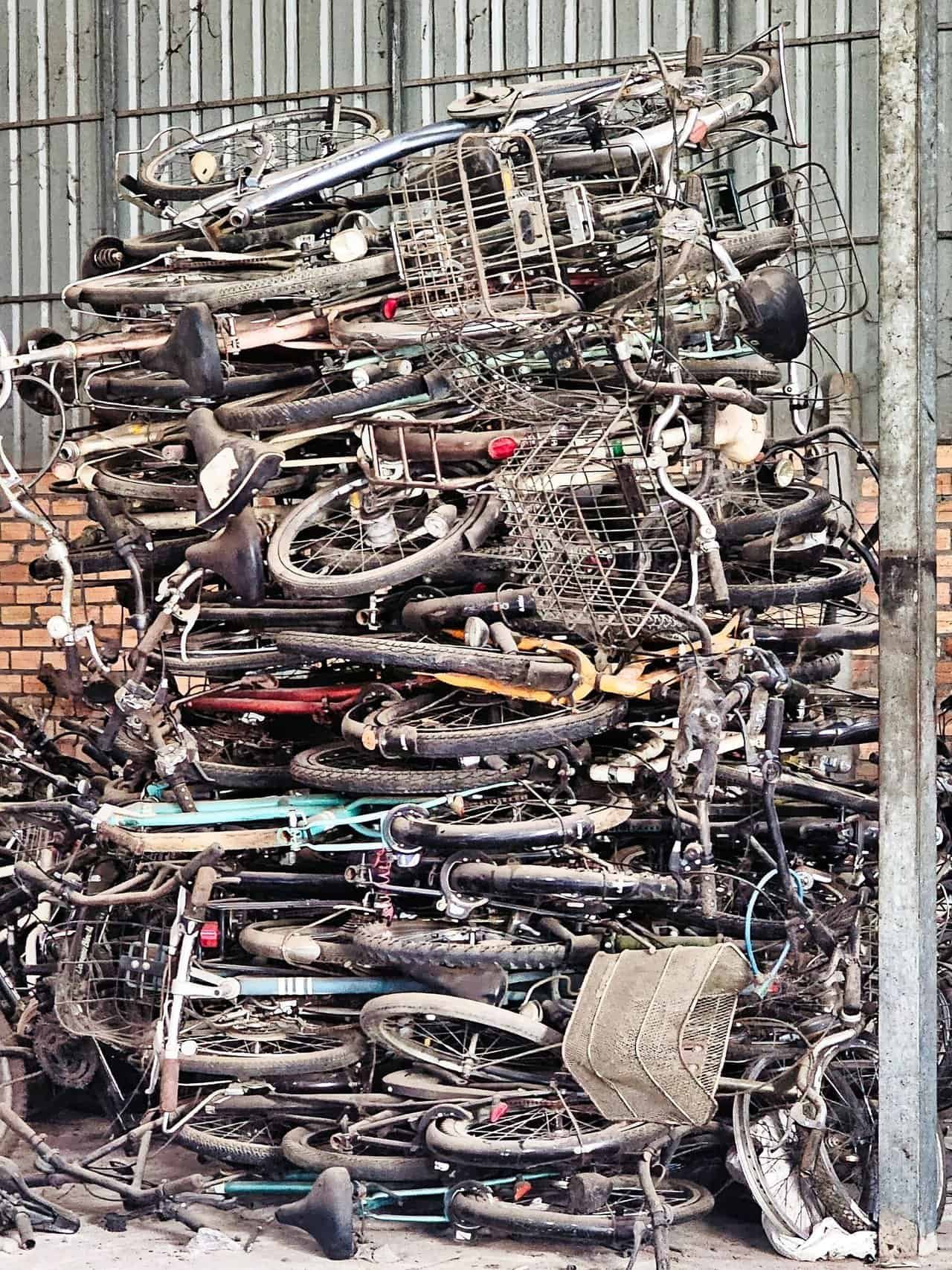
The back was the real story. A warehouse space stacked with a mountain of used bikes — every size, every style, frames piled on frames, the raw inventory of a business that runs entirely on secondhand machines. That’s where you actually shop for bikes in Cambodia. Not the tidy showroom out front. The pile in the back.
We worked through sizing with the owners and settled on mid-size and large frames to fit the students. Lisa handled the negotiating, and she’s good at it — she got the price down to around $45 or $46 per bike. We put a deposit down to hold the order, agreed the bikes would be cleaned up and road-ready, and set delivery for one week out: the following Tuesday, dropped straight at the school.
Why Cambodia Runs on Used Japanese Bikes
Worth a word on the bikes themselves, because once you notice them you’ll see them everywhere here. What Lisa bought are what Japan calls mamachari — the everyday step-through city bike. Front basket, rear rack, a dynamo light that runs off the wheel, often a built-in frame lock. Nothing fancy. Built to haul groceries, kids, and whatever else daily life throws at them.
They flood Cambodia for a straightforward reason. Japan churns through these bikes and offloads the used ones constantly, and they get shipped out by the container to markets across Asia. Cambodia’s bicycle imports come chiefly from Japan, China, and Taiwan, and shops like Osaka buy them in bulk, recondition them, and resell them for around fifty bucks a piece. The bikes that arrived for the kids proved the point: used, but with new tires, clean seats, working lights, front and rear baskets, and a few even had wheel locks. For a school buying in quantity, a reconditioned Japanese city bike is the sweet spot — cheap, sturdy, comfortable, and easy to find parts for. You can read more about the mamachari and Cambodia’s secondhand bike trade if you want to go down that rabbit hole.
Handover Day: 26 Bikes for Cambodian Kids
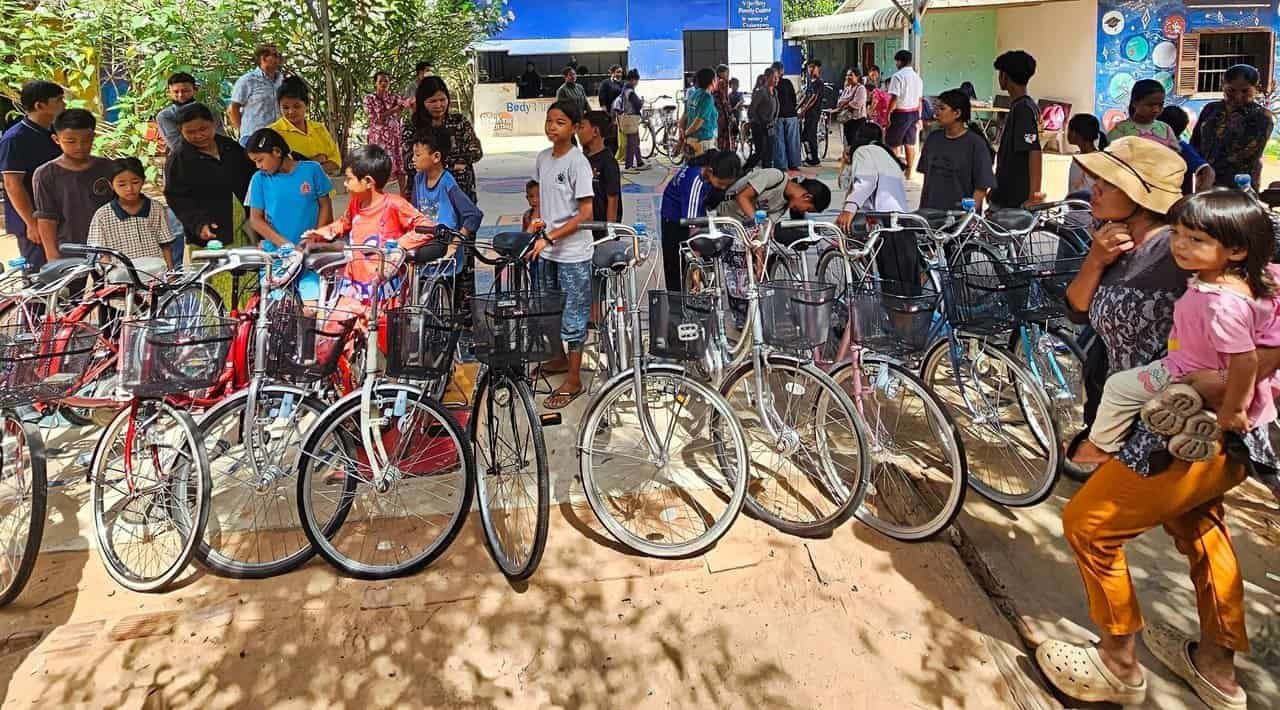
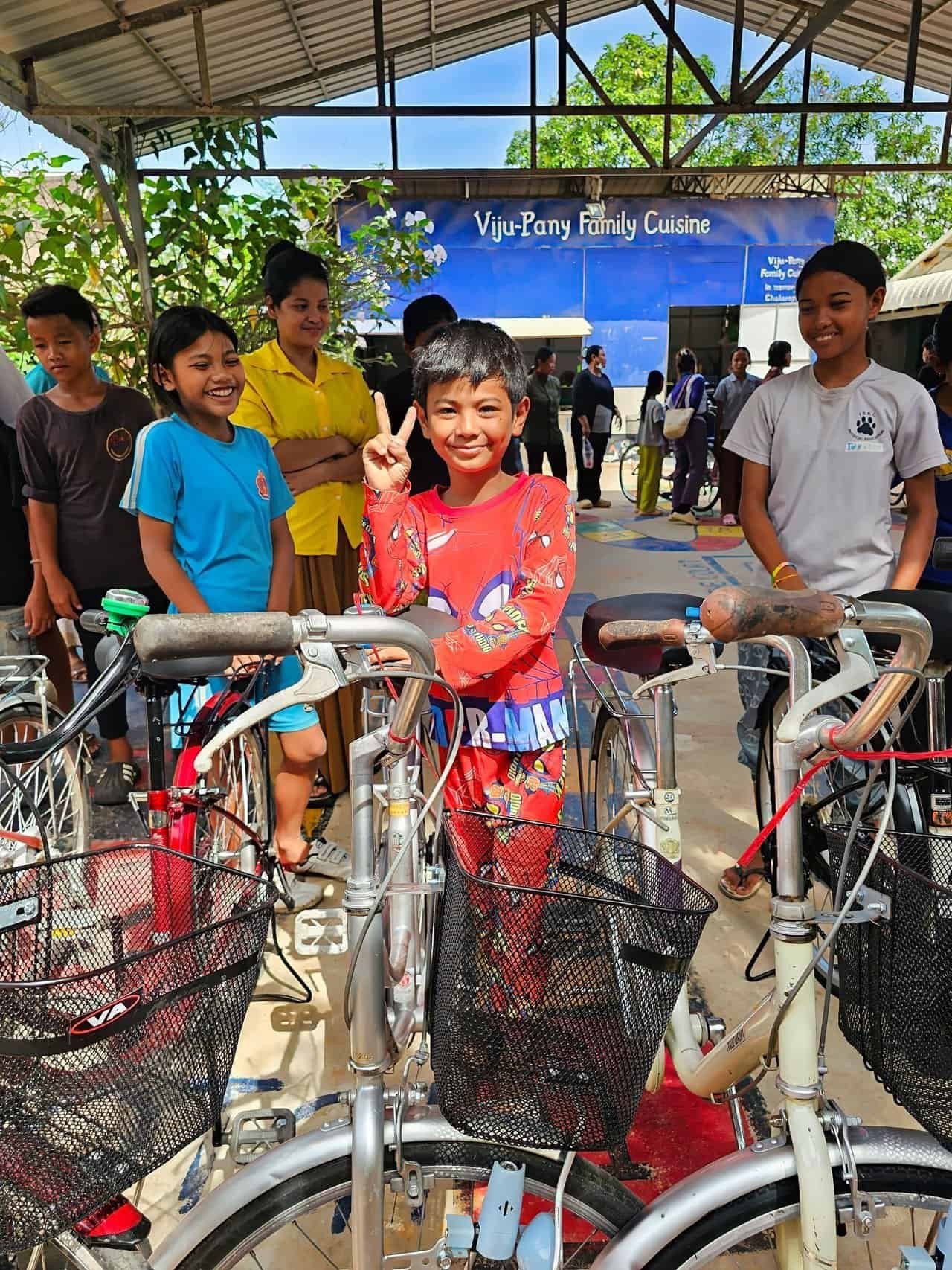
The following Tuesday I got to the school around 9:30, and the kids were already on it. The 26 bikes were lined up out in the courtyard, and the students were circling them, sizing them up, picking favorites with their eyes before anyone said they could touch a thing.
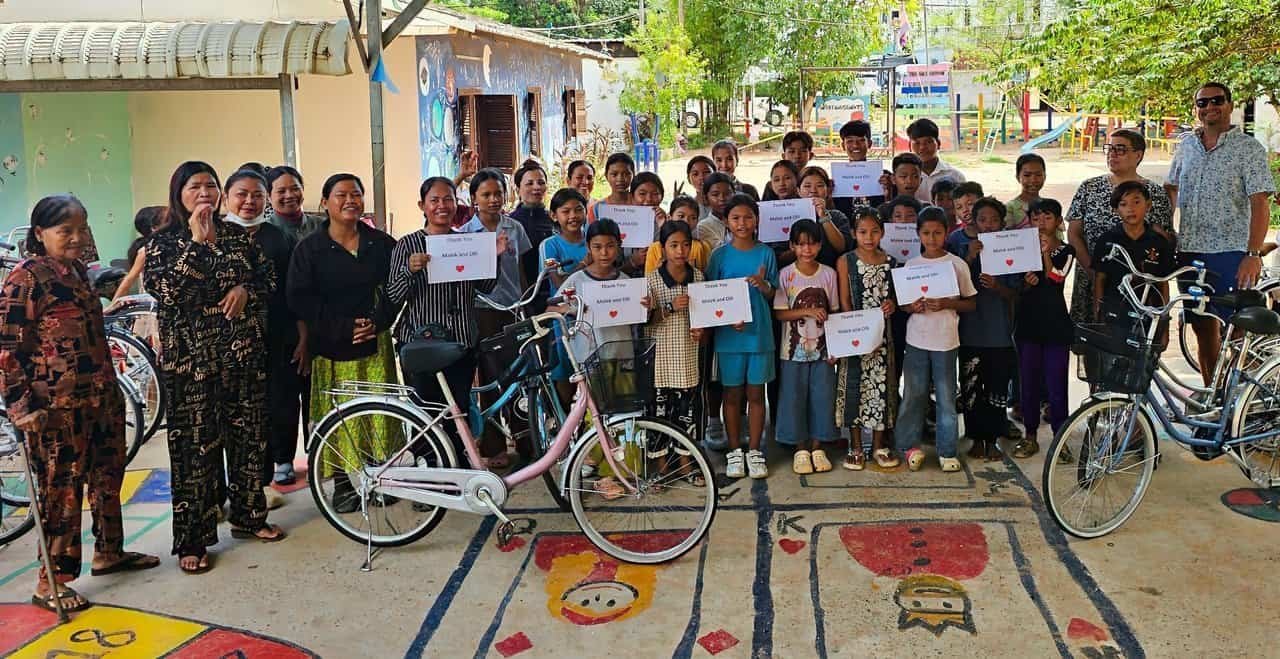
The director ran it clean. “Ladies first,” she said, and the girls went and claimed their bikes — a quick scramble, a lot of pointing, the serious business of picking exactly the right one. Then the boys got the call and went for theirs. We pulled everyone together for a big group photo — 26 kids and their new bikes — and the grins in that shot are the entire point of the exercise.
Then they rode off. I mean that literally. I walked back out to the courtyard a little later and there was nobody there. No kids, no bikes. They’d taken them home, which is exactly what’s supposed to happen. You don’t give a kid a bike so it can sit in a courtyard looking nice.
I don’t know the long-term fate of all 26. Maybe some get ridden to school every day for years. Maybe a few get wrecked doing wheelies, because kids are kids. Maybe a family in a tight spot sells one for food money — and honestly, if that’s the call a parent has to make, that’s their call to make. The bike did its job the moment it gave them the option.
The Harder Question About Giving
On the tuk-tuk ride back, Lisa said something that’s stuck with me, and it belongs in here even though it complicates the feel-good version.
Foreigners, she said, have to be careful about giving kids gifts. Do it enough and kids start associating Westerners with handouts — every foreigner becomes a walking present instead of a person, and that quietly teaches the wrong lesson. The goal is kids who work toward their own better path, not kids trained to wait for the next generous stranger to roll through.
She’s right, and it’s the kind of thing the cheerful charity posts never touch. When you come from a place of relative abundance and you want to help, it’s genuinely possible to help in a way that hurts — to create dependency while feeling good about yourself. I don’t have a clean answer for it, and neither did she. It’s a real tension anyone doing this work honestly has to sit with. What I’ll say is that these bikes were tied to a school the kids already show up for and earn their place in — not handed out cold on a street corner — and that’s about the best version of giving I can point to. But the question doesn’t disappear, and I’d rather name it than pretend it isn’t there. That’s a longer conversation for another article.
Why 26 Bikes for Cambodian Kids Is Really About Dedication
Strip away the logistics and this was never about bikes. It was about deciding to do a thing and then not stopping until it was done.
That’s what I keep coming back to. Lisa had every reasonable excuse to let this one go — the slow money, the hard weeks, the easier path of just running the next raffle and calling it enough. She didn’t. She kept the idea alive long enough for the right people to find it, and 26 kids got bikes because one person refused to quit on an idea for two and a half months straight. I think most of what actually gets done in this world runs on exactly that. Not talent, not luck. Just somebody who won’t put the thing down.
And she’s already onto the next one. Her goal now is to raise $3,000 to put fresh fruit into the kids’ school lunches for a full year. Fruit for a year isn’t a flashy headline. It won’t make anyone cry at a gala. But it’s the kind of small, steady, genuinely needed thing that adds up over time — and after watching these bikes for Cambodian kids come together against the odds, I’d put money on her getting it done.
If you’ve ever talked yourself out of something because the road looked too long, let these 26 bikes be the nudge. What’s the idea you’ve been sitting on? Drop it in the comments — I’d genuinely like to know what you’re still chasing.
This article was reviewed by ABCs and Rice ahead of publication, and all photos are used with the school’s permission. If you’d like to support their work, you can donate directly at abcrice.org. For more on getting around the Kingdom, see our Cambodia travel guide.