Hello Friends,
Here is the thing nobody tells you about moving to a small island: the beach is not the gift. The gift is what the beach does to your attention. When there is no traffic to beat, no errands to run, no reason to be anywhere by a particular hour, your eyes slow down and start finding things — a palm frond, a rotting pier, a spider on a rake. That was the real surprise of island life on Koh Rong Sanloem. Once I stopped rushing, the island kept handing me small, strange, beautiful things to look at. Here are a few of them.
Planning a Cambodia island trip yourself? This is one chapter of living on the islands — the full planning picture is in my Cambodia Island Hopping guide.
The Day a Palm Frond Fixed My Mood
It started with bad news. A Wednesday, the whole hostel moving slow after the previous night’s event, and then some disappointing word about a client project that dropped me into a proper funk. Island life does not buffer you from that stuff — it just gives you a nicer backdrop to stew in.
So I walked the beach to shake it off, and a palm frond lying in the sand reminded me of something I had always wanted to try: palm-leaf folding, the craft I had watched street vendors do all over Southeast Asia, turning a single leaf into a fish or a hat with nothing but their hands. I grabbed a handful, ordered a dragon fruit smoothie at a beachside restaurant, and pulled up tutorials on my dying phone.

First lesson, learned immediately: you do not rip the fronds off the stalk like kindling. You keep the stalk intact and split them methodically, because the leaf has a structure and it wants to fold along it. Work with that architecture instead of against it and everything gets easier. Naturally, I figured this out only after wrecking my first batch.
Learning to Fold Fish, and the Vietnam I Remembered
I had wanted to make one of those conical palm hats, the ones that look simple and absolutely are not. After botching the material prep, I dropped down to something more forgiving: a palm-leaf fish. The first attempt looked like abstract art. The second looked like something that went extinct a few million years ago. By the fourth or fifth, I had a recognizable fish, and then I got ambitious and wove a couple of palm-leaf rings on top of it.
Here is what surprised me. Once you stop fighting the leaf, the whole thing turns meditative. Your hands learn the fibers, you feel how much pressure makes a fold instead of a tear, and the repetition stops being frustrating and starts being calming. Sitting there working through failed folds over a smoothie, the client-work stress just quietly dissolved — not because folding a leaf solves anything, but because it demands the kind of present-moment focus that leaves no room for spiraling.

It brought back the old guys I used to watch in Vietnam, the ones selling folded cricket cages and animals made entirely from fronds, their hands moving with decades of muscle memory. What I was doing was tourist-level fumbling. But it gave me real respect for a craft that families have passed down for generations. Before I left, I rigged a little fishing line and gave my best fish to a kid at the restaurant. The look on his face was a good reminder that a thing someone made by hand carries a different weight than a thing you buy.
Koi Scales and the Art Nobody Sees
The folding cracked something open, because the drawing came next. Georgia O’Keeffe had her flowers. I have my koi. During the downtime here — the hours when you are not swimming, not working, not exploring — I have been filling sketchbooks with them, and it has become as much a part of the routine as the morning swim and the avocado coffee smoothie everybody tells me sounds disgusting.
The process is simple. A mechanical pencil, HB lead, a rough sketch to place the body and the curve of the fins. Then the ink outline, which is where the drawing commits and you can no longer erase. Then the dark outlines and the internal hash marks that make it pop, the scales, the fins, the background of flowers and wind lines that keeps the fish from floating in empty white space.

The scales are the meditative part. Each one has to follow the curve of the body and overlap its neighbors, and getting the points to line up is the whole challenge — too messy and it looks amateur, too perfect and it dies. You are walking a line between control and flow, hundreds of tiny decisions that add up to something that hopefully looks alive. The koi swims upstream, against the current, which in a lot of Asian traditions stands for perseverance and luck. That felt about right for a year spent committing to seven months on an island and drawing through the tail end of an illness. These drawings will never hang in a gallery. They exist for the process and for the handful of people who see them online, and there is a real freedom in making something with no commercial purpose attached to it.
A Starfish, a Negroni, and the Bar
Not all of it happened in daylight. One night I was sitting at the local bar with a negroni when it hit me that, after more than a month surrounded by marine life, I had somehow never drawn a starfish. The idea had actually started earlier that day, sketching on the beach with a friend, letting the conversation drift while the pencil moved. That evening the negroni was the creative fuel, and I opened the sketchbook and started with the most basic five-armed shape I could manage.
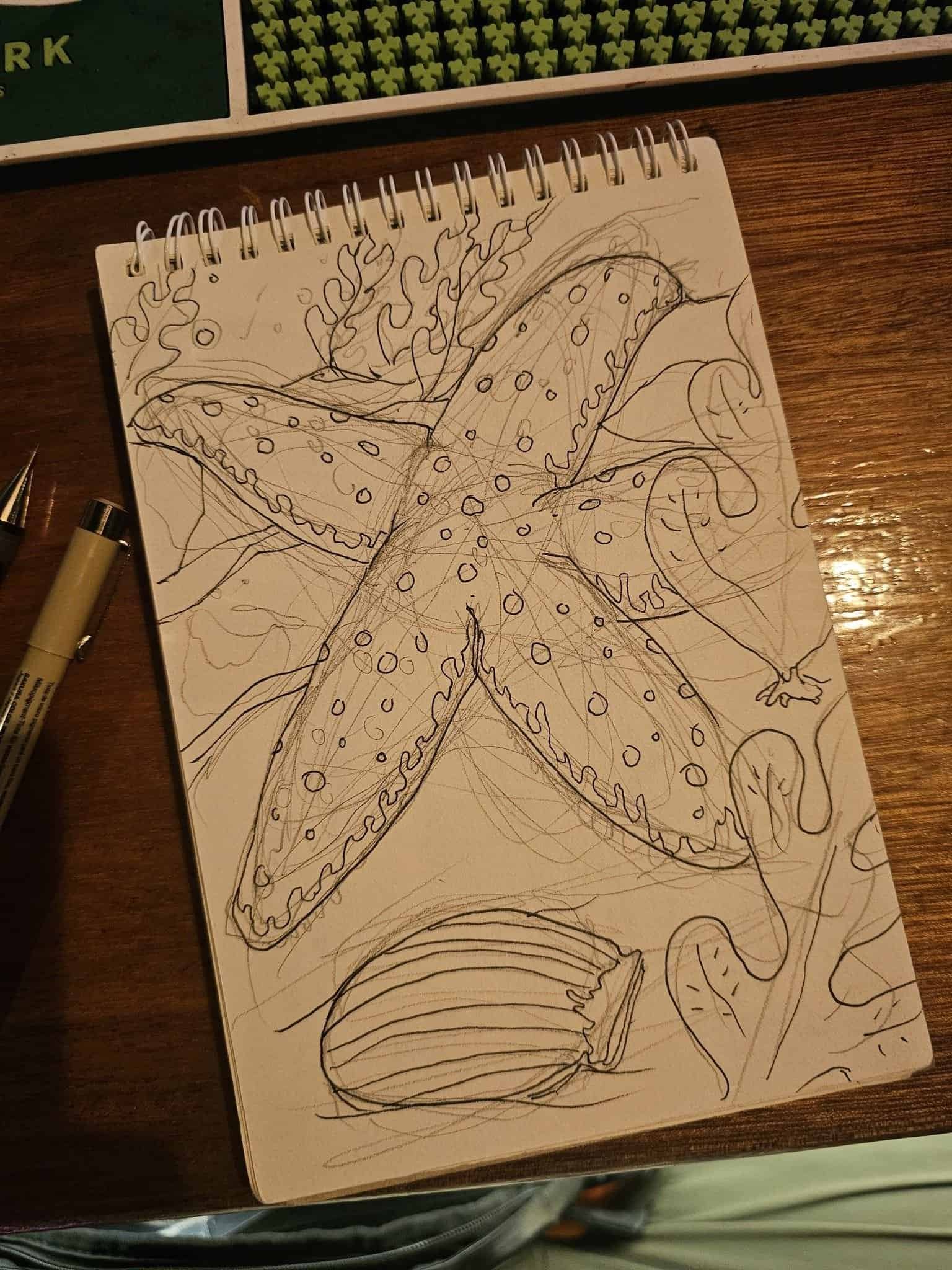
Ink changes everything, because there are no second chances — every line has to count. But the real transformation came from crosshatching, layer over layer of intersecting lines building shadow and depth until the thing stopped looking flat and started resting on a surface. I built a little underwater world around it, coral and a shell for scale, then let the eye rest where the background got looser. That is the whole lesson, really: art happens everywhere, not just in studios. Sometimes it is just a moment of curiosity and a pen, over a negroni at the bar.
The Thirty-Minute Walk to the Old Pier
For weeks I had been eyeing an old pier at the far end of the beach from my usual swimming spot, its weathered silhouette promising exactly the kind of photogenic decay that makes island exploration worth the sweat. One afternoon I needed to clear my head, so I finally made the walk — thirty minutes each way through a stretch of Koh Rong Sanloem I had never properly crossed.
The walk turned into the point. What looks like a straight beach stroll is really a passage through different little worlds: tidal pools and water outlets that fill into temporary lagoons when the tide runs high, then a narrow sandbar with local fishermen’s houses tucked so naturally into the landscape you almost miss them. Simple working homes for people whose whole lives revolve around these tides. It landed on me as I passed: I am a temporary visitor with seven months to document this place, walking past homes of people whose entire existence centers on this exact stretch of sand.
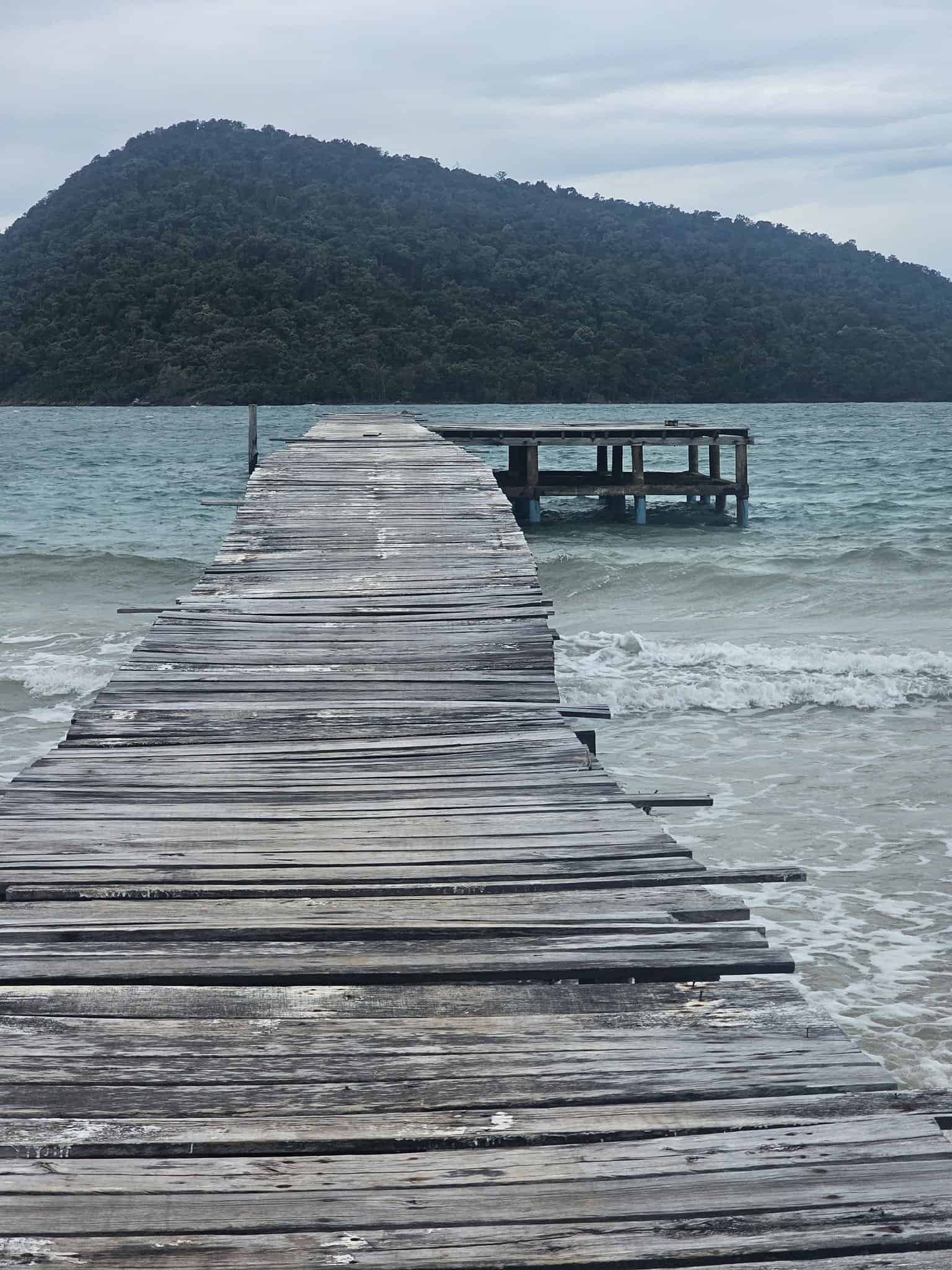
Up close the pier had that perfect gray-brown color that only comes from years of sun and salt, some sections solid, others clearly telling me to proceed with caution. I stepped on carefully, the boards creaking and bouncing enough to make the message obvious, and settled onto a stable section near the base rather than finding the weight limit the hard way. Sitting there on a structure that is slowly surrendering back to the ocean, watching waves roll toward small distant islands, everything shrinks to the right size. Deadlines, equipment failures, social obligations — all of it gets small when you are measuring time in tide cycles. The walk back felt completely different from the walk out, the same fishermen’s houses now part of a whole picture instead of curiosities on the way to somewhere.
What Washes Up Overnight
The beach at sunrise is a different kind of classroom. One morning I spotted what looked like a fish thrashing in a tidal pool and went into full rescue mode, scanning the sand for a bucket. Got close, and the harsh truth revealed itself: the cuttlefish was very much dead, and the “thrashing” was small fish picking at the carcass. Death feeds life, right there in the shallows before breakfast.
I had never seen a cuttlefish up close. The oval cuttlebone is a genuinely alien piece of engineering, smooth white calcium carbonate that controlled the animal’s buoyancy in life and now just sits there as evidence of what lives out past my swimming depth. A little further on I found a black insect with antennae twice the length of its body, and then a second, better-preserved cuttlefish — two in one walk, which tells you they are out there in numbers even though I have never once spotted a living one while snorkeling. That is my new mission now: get out past the sandy shallows toward the coral and see one alive.

This is the part that gets lost behind the postcard. The beach is not just a backdrop — it is a working ecosystem, a morgue and a recycling center that processes whatever the ocean delivers in the dark. Every sunrise leaves new evidence of the complexity happening below the surface.
The Spider Ballet
And then there was the morning I wasn’t looking for a life lesson at all. I was opening the bar, raking up the overnight debris, when something on the metal tines caught my eye: a black spider with a shiny, almost metallic shell, sitting perfectly still in the morning light like a piece of living jewelry. Photogenic little dude. I pulled out my phone.
That is when a second spider entered the frame — big, fuzzy, moving with purpose, the total opposite of the sleek one. My buddy helping me set up grinned and figured we were about to witness some spider romance. We were both wrong. The fuzzy one launched itself through the air like a furry missile, landed square on the black spider, and sank its fangs in, pumping so much venom I could actually see it flowing out. Not courtship. A straight ambush.

Here is the strange part — even in the middle of that, it was beautiful. The morning light on both of them, the precise choreography, the raw efficiency of a predator that had clearly done this many times, wrapping its catch in web and suspending it from a strand of silk to feed. A ballet, just not the one we expected. I watched a good ten minutes, then carefully moved the rake and both spiders into the bushes so they could finish in private, and went back to opening the bar. We spend most of our lives too busy or too glued to a screen to catch these tiny dramas, and they are playing out constantly, everywhere, if you slow down enough to look. Beauty and brutality are not always separate categories. Sometimes they are the same three minutes.
What Island Life on Koh Rong Sanloem Actually Teaches
None of this was on any itinerary. I did not come to Koh Rong Sanloem to fold palm leaves, draw koi over a negroni, or referee a spider fight at dawn. But that is exactly the lesson. Strip away the convenience and the constant connectivity, hand someone unlimited time and a slower pace, and the ordinary world turns out to be packed with stuff worth paying attention to. The island did not give me adventures so much as it gave me my attention back.
If you missed the harder side of this chapter, it is in the story of the two weeks I spent flat on my back getting sick on the island with no pharmacy in reach, and the earlier stretch is in my first week here and my month-one reality check. The palm-folding, by the way, is a distant cousin of the night I spent making a lantern in Hoi An years earlier. These days I am off the island and based inland, which I write about in my Siem Reap travel guide.
If you want to go down the same rabbit holes I did, the MBARI cuttlefish page is a good start on why those cuttlebones are such strange little machines, and palm-leaf weaving is an art form with real history across Asia. Slow down and the island will show you the rest. Cheers.