This is one piece of my full Siem Reap Travel Guide — a local’s take on the town I call home.

Angkor Wat Sunrise: 7 Honest Truths From My Temple Day
The plan was simple. My friend would pick me up at 5:30 a.m., we’d catch the Angkor Wat sunrise together, and I’d finally cross the temple off the list after months of living in Siem Reap. I set my alarm for 4:45, took a quick shower, walked downstairs, and waited. And waited. At 6 a.m., my phone buzzed. They had overslept. Go on without me, they said. I’ll meet you there.
So that’s how visiting Angkor Wat became a solo mission before I’d even reached the gate. I opened the Pass app, booked a tuk-tuk for 11,300 riel (about $2.80), and twenty minutes later I was standing at the long stone causeway leading up to the three iconic spires you’ve seen in every history textbook. What followed was a nine-hour day that left me sunburned, exhausted, and conflicted about whether I’d ever go back.
This isn’t your typical glossy temple guide. After 8 months living in Cambodia and writing about Southeast Asia for The Roaming Sparrow, I had high expectations for visiting Angkor Wat. Some were met. Others got steamrolled by reality. Here’s the unfiltered truth about the crowds, the costs, the photographers hustling you for a dollar, and the temples themselves — which are, despite everything else, genuinely worth the trip at least once.

Buying Your Angkor Wat Ticket: $37 and a Vending Machine
The day before my visit, I rolled into Heritage Walk Mall in Siem Reap to grab my pass. The Angkor Enterprise office runs an automated vending machine system that takes about two minutes start to finish. Touch the screen, pick your language (English, Khmer, Chinese, Japanese, or Korean), insert your card, snap your photo if you’re going for a multi-day pass, and walk out with a printed ticket and QR code.
The current Angkor Wat ticket price in 2026 is $37 for one day, $62 for three days, and $72 for a week. These prices haven’t changed since 2019. You can also buy online at angkorenterprise.gov.kh, at the main ticket office on Road 60, or through your tour guide. Pro tip: buying the day before means you skip the 5 a.m. queue entirely. That matters when sunrise photos are the whole point.
One thing worth knowing if you’re a long-term resident: foreigners who’ve lived in Cambodia for two years or more can apply for a free yearly pass at the Angkor Ticket Office with passport proof. I’ve only been here 8 months, so the $37 was on me.
Angkor Wat Sunrise: Crowds, Hustlers, and the First Ticket Check
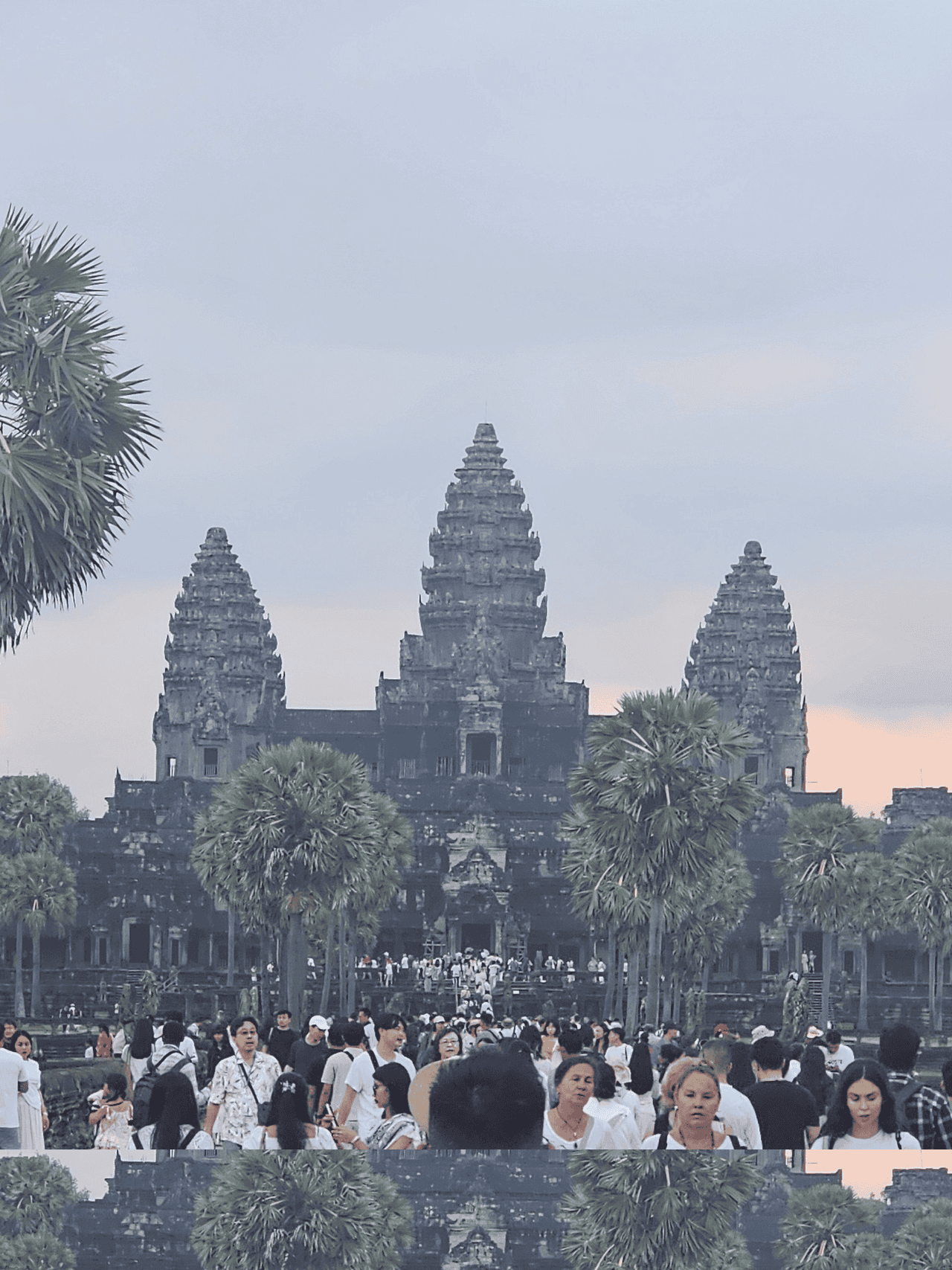
Stepping out of my tuk-tuk at 6:15 a.m., three things hit me in quick succession. First, the crowd. Even at this hour, hundreds of people were streaming in and out of the entrance. Second, the photographers. Within ten seconds, two of them had approached me offering to take my picture for a dollar. Third, the ticket checkers.
Now here’s something worth flagging. Throughout the day, I’d be stopped multiple times to show my pass while groups of Asian-looking visitors walked by unchecked. Cambodian nationals and long-term residents do get free entry, so I understand the logic of spot-checking foreign-looking visitors. Still, getting singled out four separate times when you’re clearly carrying a valid ticket gets old fast. Worth knowing if you’re heading there with similar features.
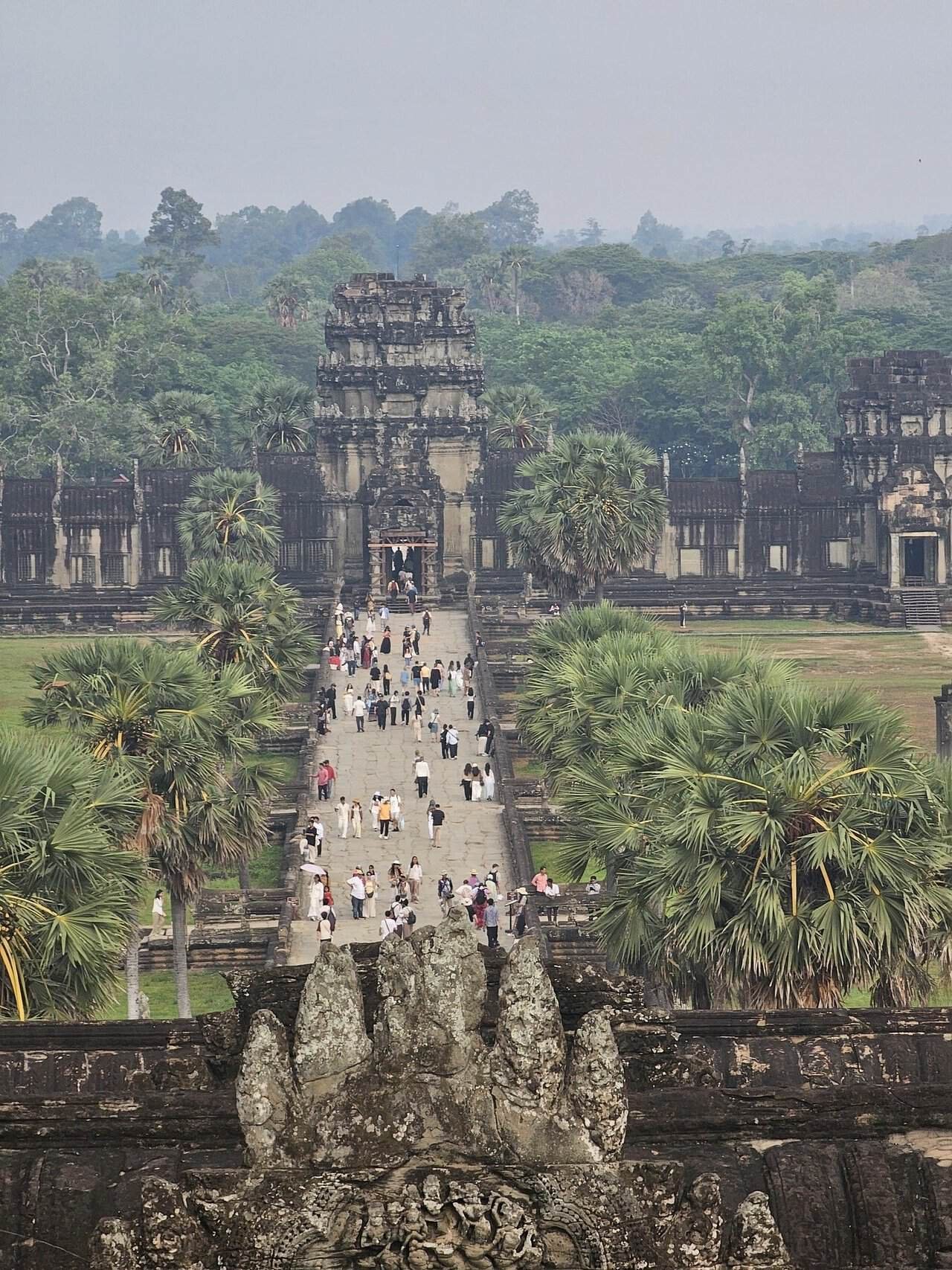
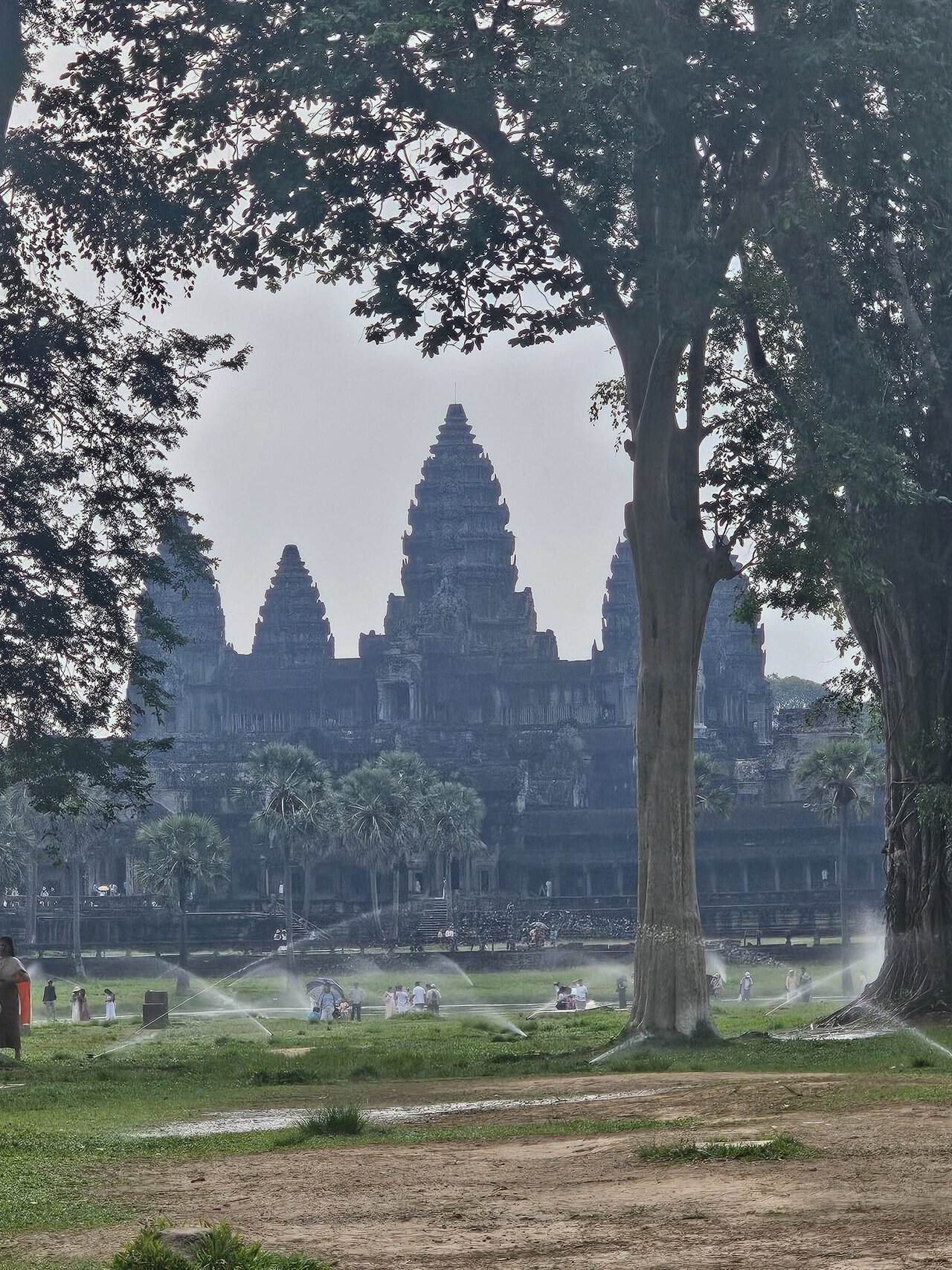
I waved off the photographers, showed my ticket, brushed past a third group asking if I needed a tour guide, and walked toward the temple. The sun was still hanging low. Mist was lifting off the moat. The stone causeway stretched out ahead, and the three towers rose in the distance just like every photo I’d ever seen of this place.
Something that surprised me: how well-dressed everyone was. Yes, there were the occasional shorts-and-t-shirt tourists, but most people had clearly put effort in. Light dresses, button-up shirts, scarves. Visiting Angkor Wat at sunrise apparently calls for your A-game wardrobe, and luckily I had gotten the memo. The day before, my friend had taken me to a local shop in Siem Reap where I picked up a pair of linen pants and a cotton shirt for about $13 total. Smart move. The linen breathed in the heat, the long pants got me past the dress code at the upper levels, and I didn’t look like I’d just rolled out of a hostel.

Inside the Main Temple: Stone Carvings and the Climb to the Top
Past the first stone gateway, you emerge onto a massive open lawn with Angkor Wat’s three towers rising at the far end. Couples were posing for photos. Kids ran across the grass. Photographers had their models holding still in golden hour light. It’s the kind of scene that makes you understand why this place is the largest religious monument in the world, sitting on 162.6 hectares.
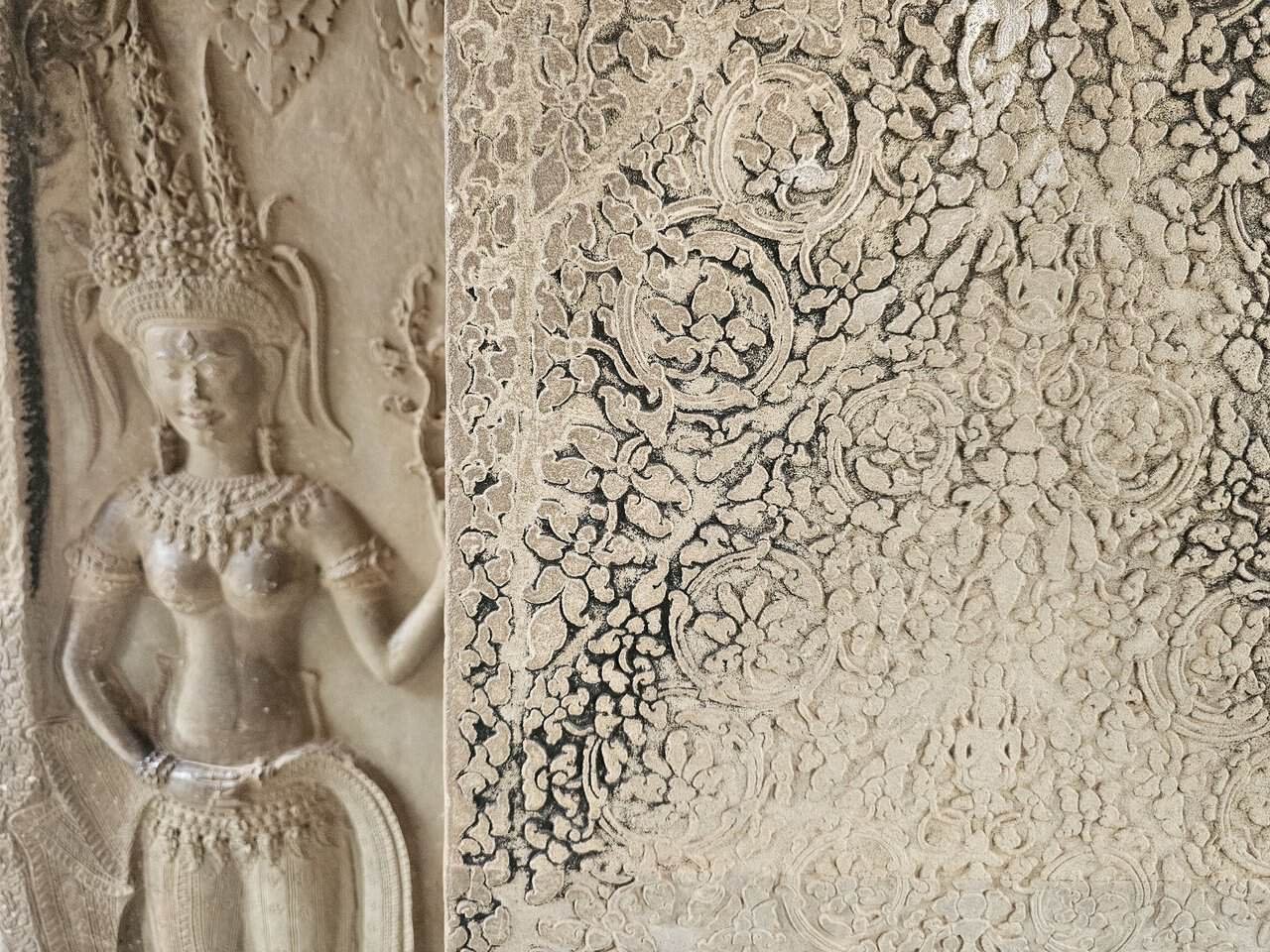
The walk down the inner causeway leads you into the main temple complex, where the real magic happens. Almost every stone surface is covered in carvings. Bas-reliefs of battles, dancers, gods, and everyday Khmer life from the 12th century, when Suryavarman II commissioned the place. I kept thinking about how it must have looked when those carvings were freshly painted in their original colors. Today they’re worn smooth in places, but the detail is still staggering.
Inside the temple proper, there’s no artificial lighting. Sunlight filters through doorways and windows, creating sharp contrast between bright pools and deep shadow. You move from chamber to chamber by feel as much as sight. I worked my way around to the back, past some scaffolding where conservators were carefully recarving stone to fill in damaged sections, and queued up for the wooden staircase leading to the top tower.

The climb is steep. Real steep. The original king’s stairs are blocked off (and probably for good reason, given the angle), but the modern wooden replacement isn’t much friendlier. At the top, you wander four sections around a central shrine, with views in every direction. From the front face, looking back down the causeway toward the morning haze, I finally got it. This is why people come.
The Descent and Meeting Up With My Friend
Getting down was its own adventure. The exit staircase had a 15-minute queue when I reached it. Nobody could move. I stood there imagining what would happen if anyone slipped on those steep steps — they’d take half the line down with them. While I waited, my friend called to say they’d finally arrived. Good timing, in a way.
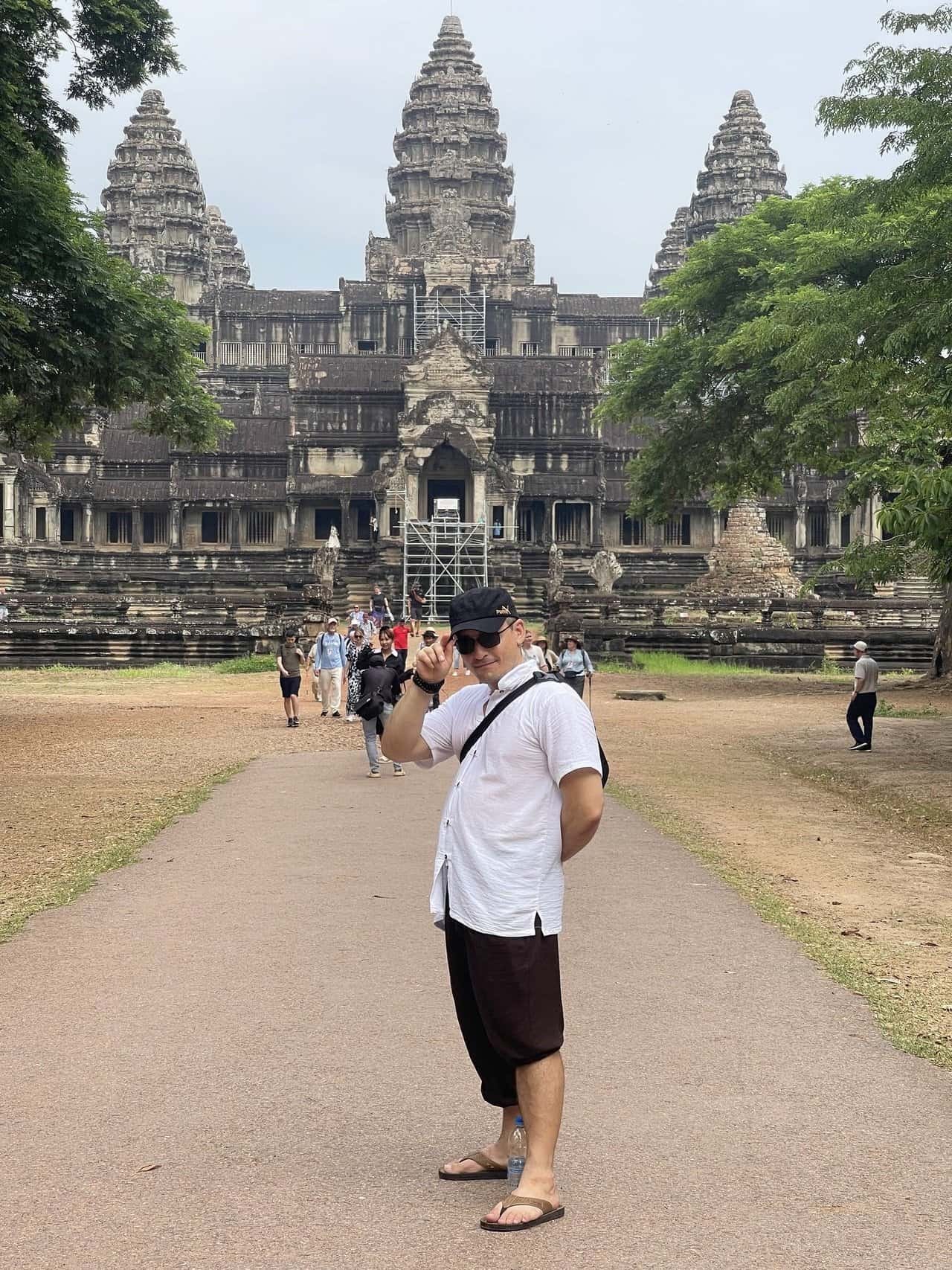
The line eventually started moving, and I sidestepped down the stairs and back to the great lawn. We met near the main entrance, and they immediately took me on a different path around the left side of the temple, through some framing spots they knew from previous visits. Stone archways with trees in the background. The kind of angles you don’t find without a local. Their photo skills made me look way better than my selfie attempts had.
On the way out, we passed a troop of macaques with babies clinging to their bellies. Signs nearby read “Caution: Monkeys Bite.” They didn’t bite. They mostly ignored us, doing whatever monkey business macaques do on a Saturday morning. Then we stopped at the Starbucks just outside the complex for an actual break, because two hours of walking, climbing, and dodging photographers had put me in caffeine debt.

Bayon Temple: 200 Smiling Stone Faces
My friend had brought a motorbike, which is genuinely the right move for getting around the Angkor Archaeological Park. You can walk it, but it’s a long, hot walk between sites. Tuk-tuk, motorbike, or bicycle is the way. We headed north toward Bayon, which sits at the center of the ancient walled city of Angkor Thom.
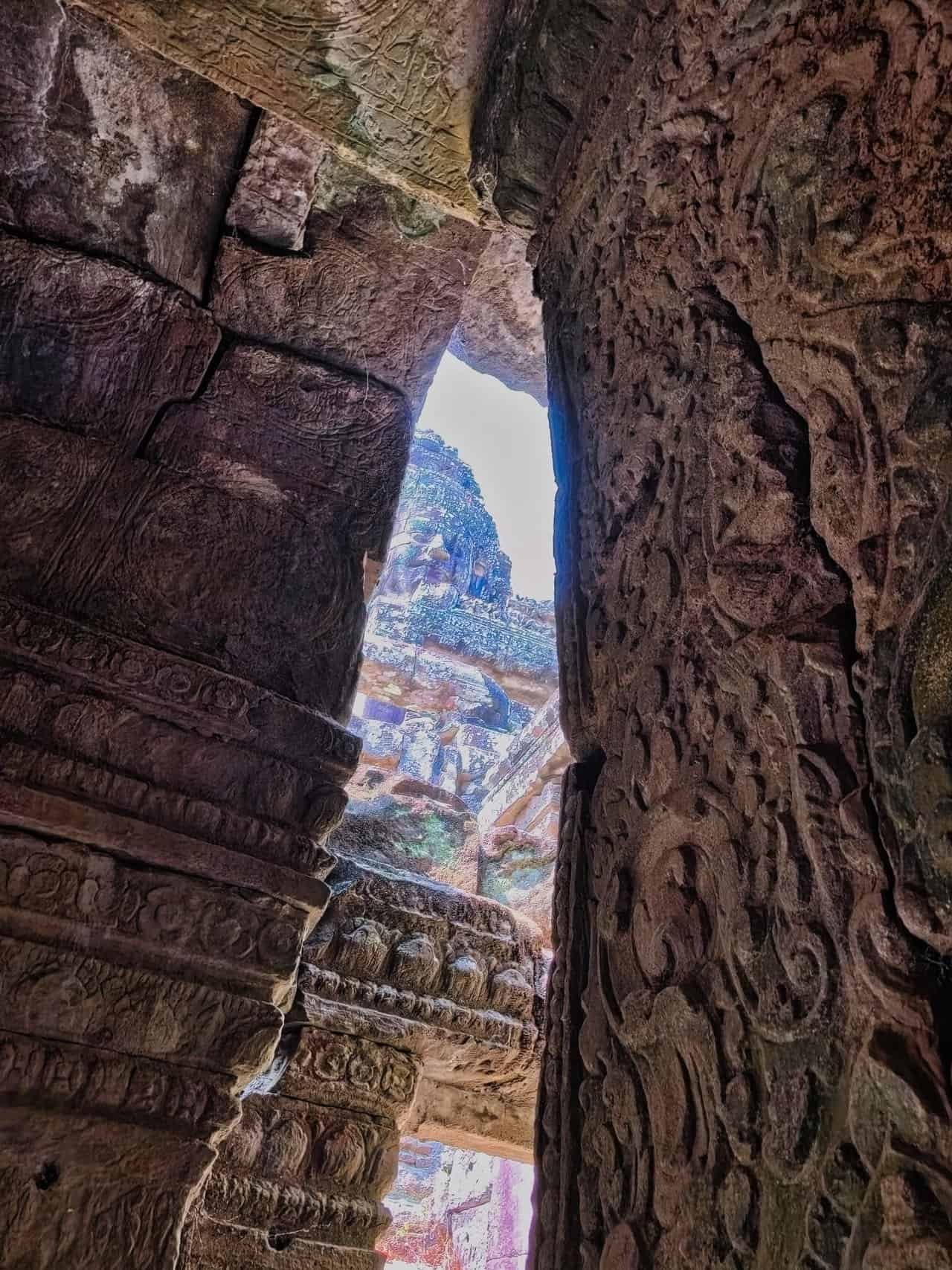
Crossing the bridge into Angkor Thom, our motorbike got pulled over. Cars and other bikes zipped past unchecked. I was the one asked to show my ticket. Strike two. I showed it, we rode on, and I parked any frustration to focus on what came next, because Bayon turned out to be the temple I didn’t know I was waiting for.
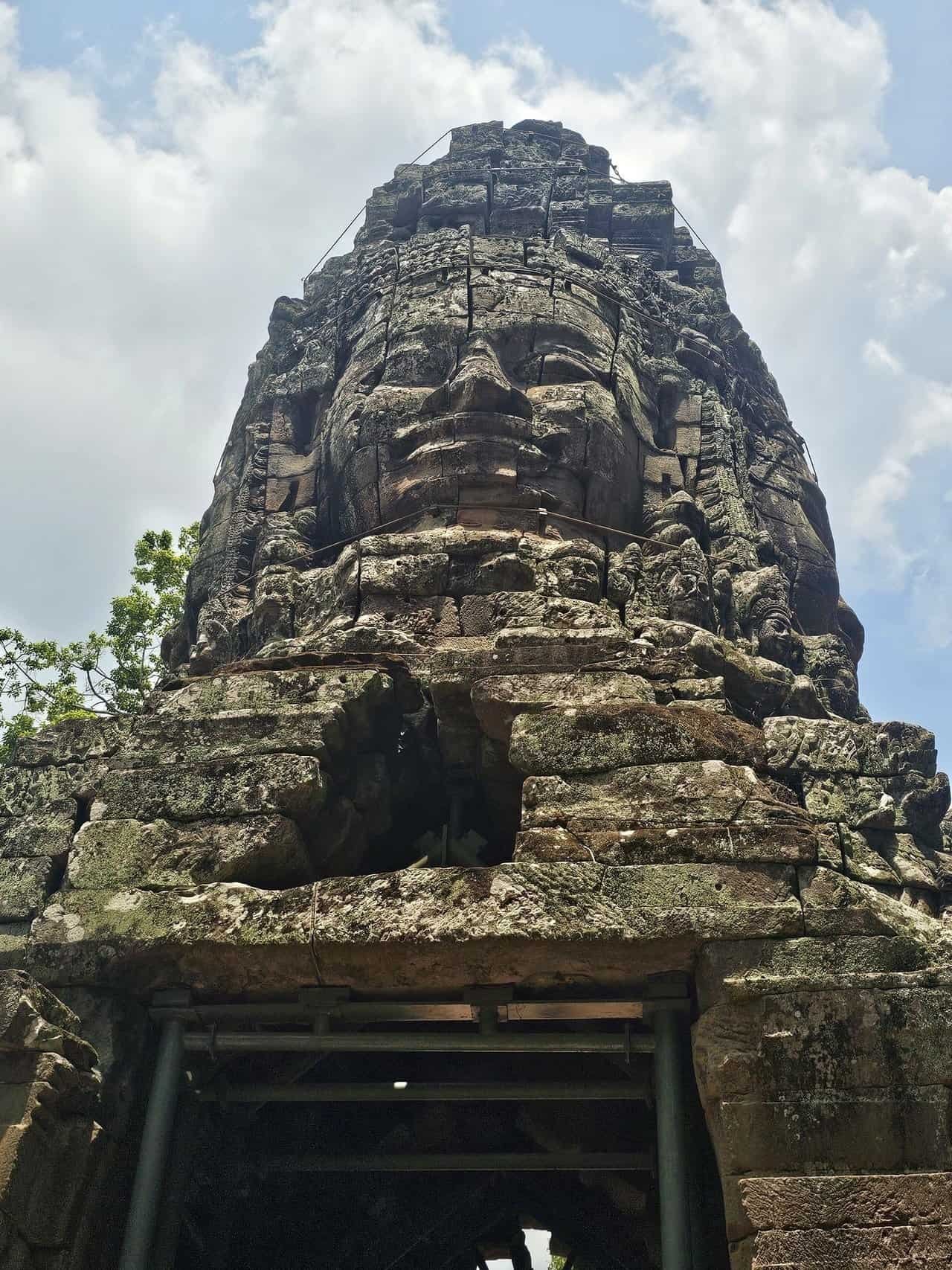
King Jayavarman VII built Bayon in the late 12th and early 13th century as the state temple of his new capital, Angkor Thom. It’s the only Angkorian state temple built primarily as a Buddhist monument. The defining feature is the 216 enormous stone faces carved into 54 towers, smiling serenely down at every visitor. Some scholars think they represent the bodhisattva Avalokiteshvara, the embodiment of compassion. Others think they’re stylized portraits of Jayavarman VII himself. Probably both.
The temple feels older and more weathered than Angkor Wat. Walking through the inner corridors, you look up through cracks in the stone and see those giant faces glowing in shafts of sunlight. The carvings are everywhere — bas-reliefs of naval battles, market scenes, daily life from 800 years ago, all in remarkable detail. The whole place felt like something from a Disney World ride, except real, with actual centuries of patina on every surface.
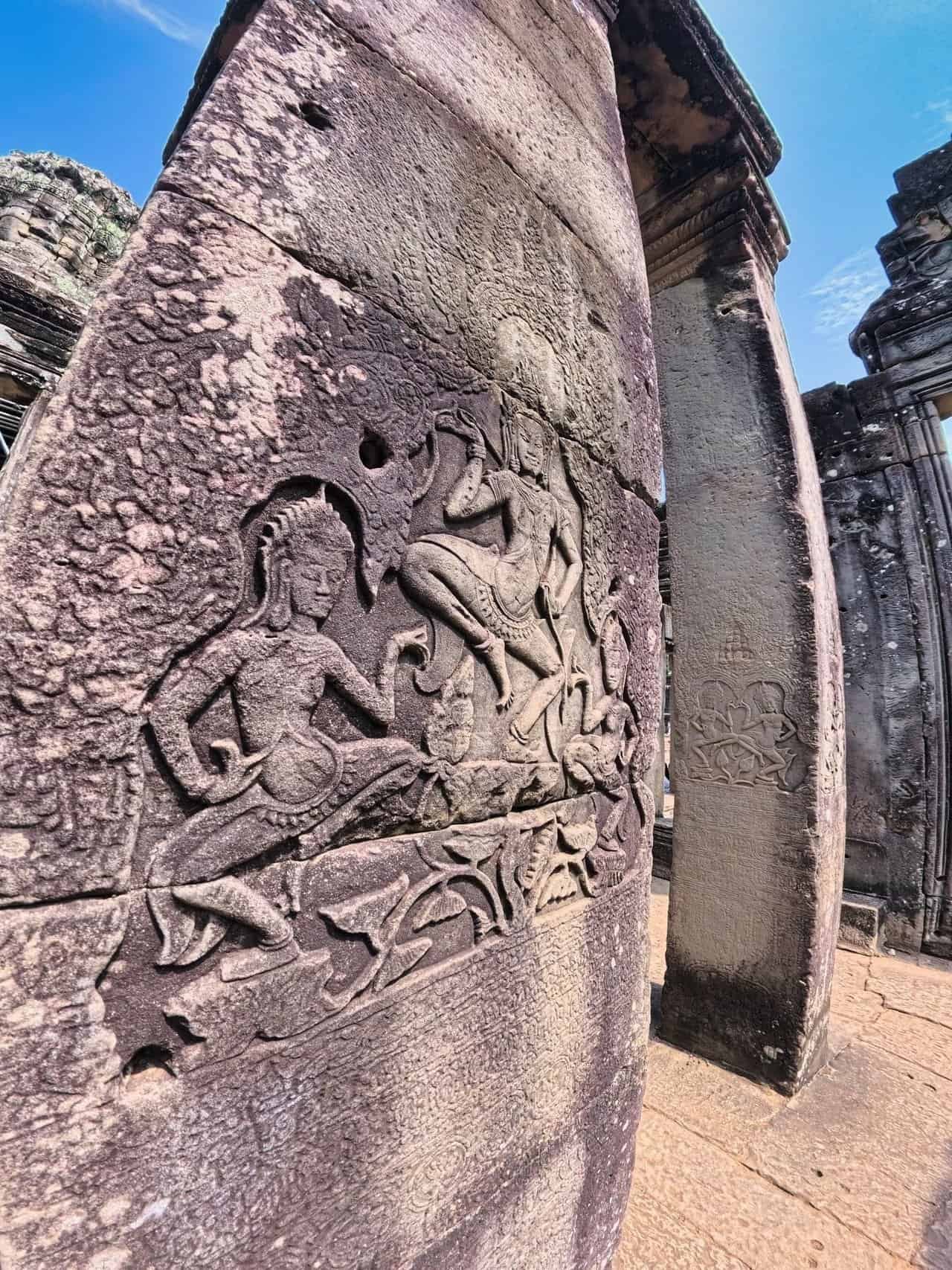
The soundtrack for our visit was a group of monks chanting from across the road. The sound echoed through the chambers. We sat in the shade on the western side for nearly an hour, just looking and listening.
Ta Prohm: The Tomb Raider Temple
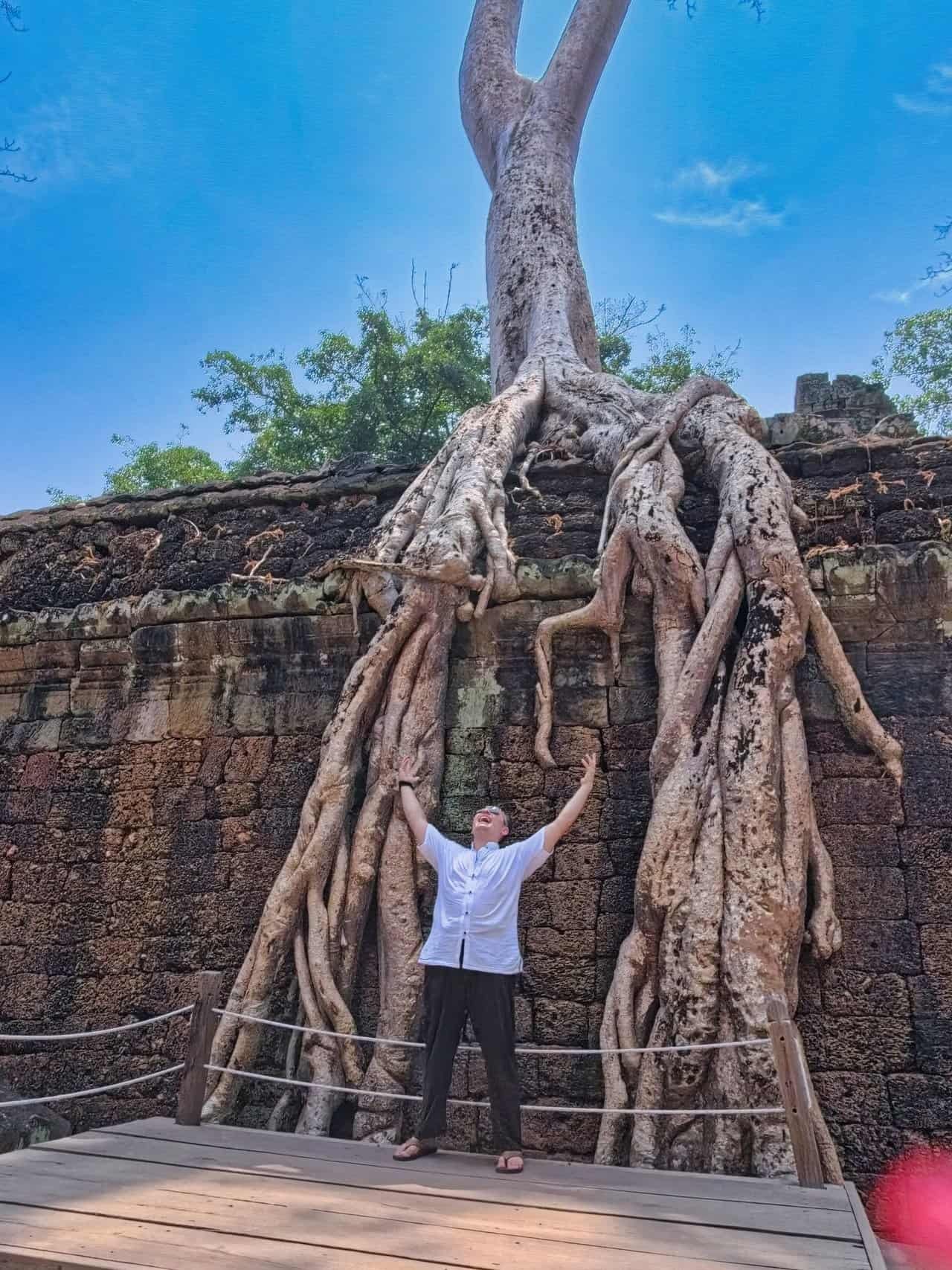
Next stop, the temple Angelina Jolie made famous. Ta Prohm sits about a kilometer east of Angkor Thom and was built by Jayavarman VII in 1186 as a Mahayana Buddhist monastery dedicated to his mother. Originally called Rajavihara — “monastery of the king” — it housed nearly 80,000 people including 18 high priests and 615 dancers, according to inscriptions found on its stele.
The drive there was actually one of the highlights of the day. The roads inside the park wind through dense jungle, with ancient ruins peeking through the trees on every side. My friend pointed out the Eleven Princesses ruin as we passed. The whole place feels less like a tourist site and more like driving through a living archaeological zone. I’d come back just to ride these roads at sunset.
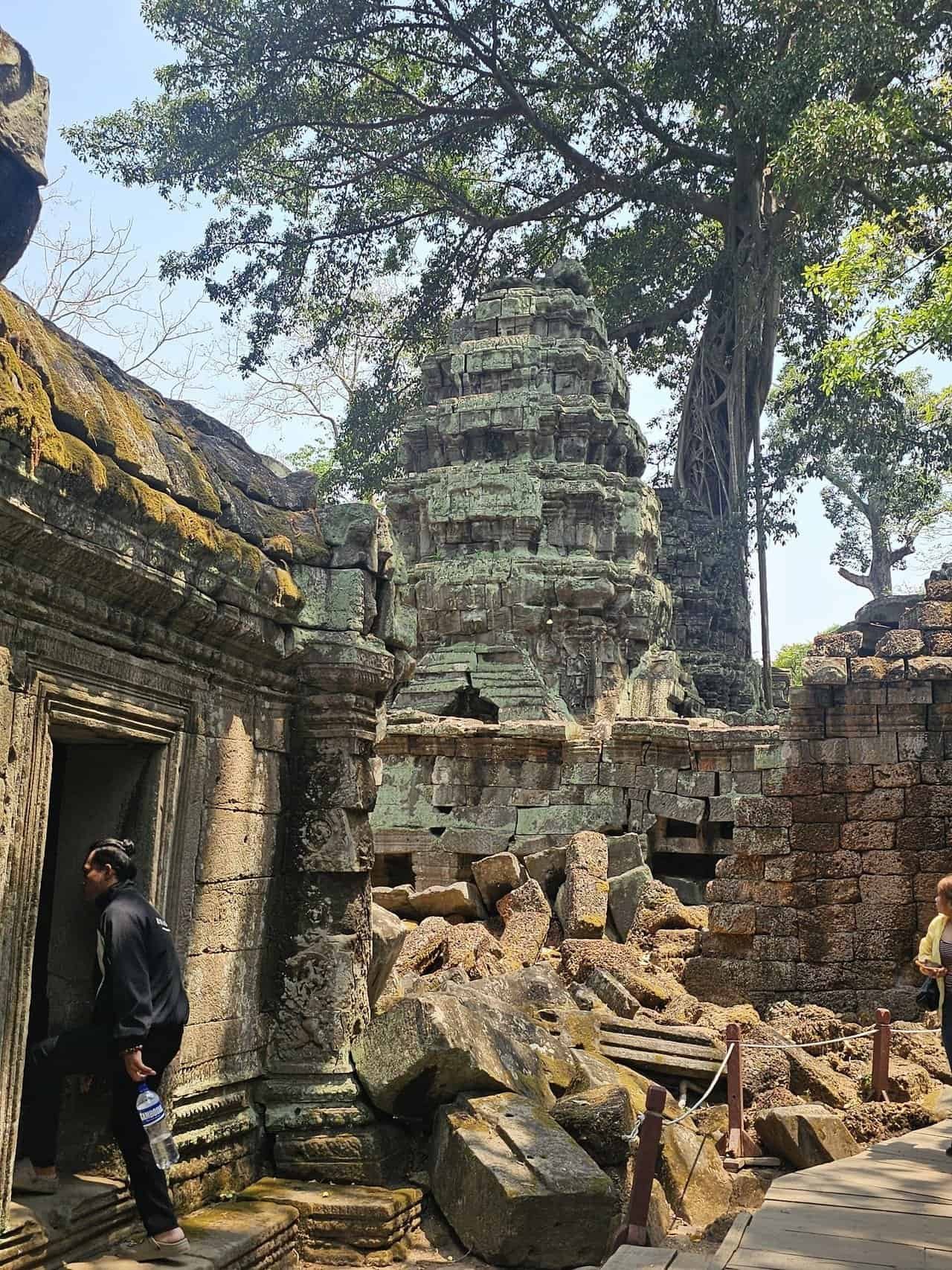
We arrived at Ta Prohm and parked. Walking through the main arch, I was stopped — alone — and asked for my ticket while everyone else streamed past. Strike three of the day. By this point I was just rolling my eyes and showing the QR code on autopilot.
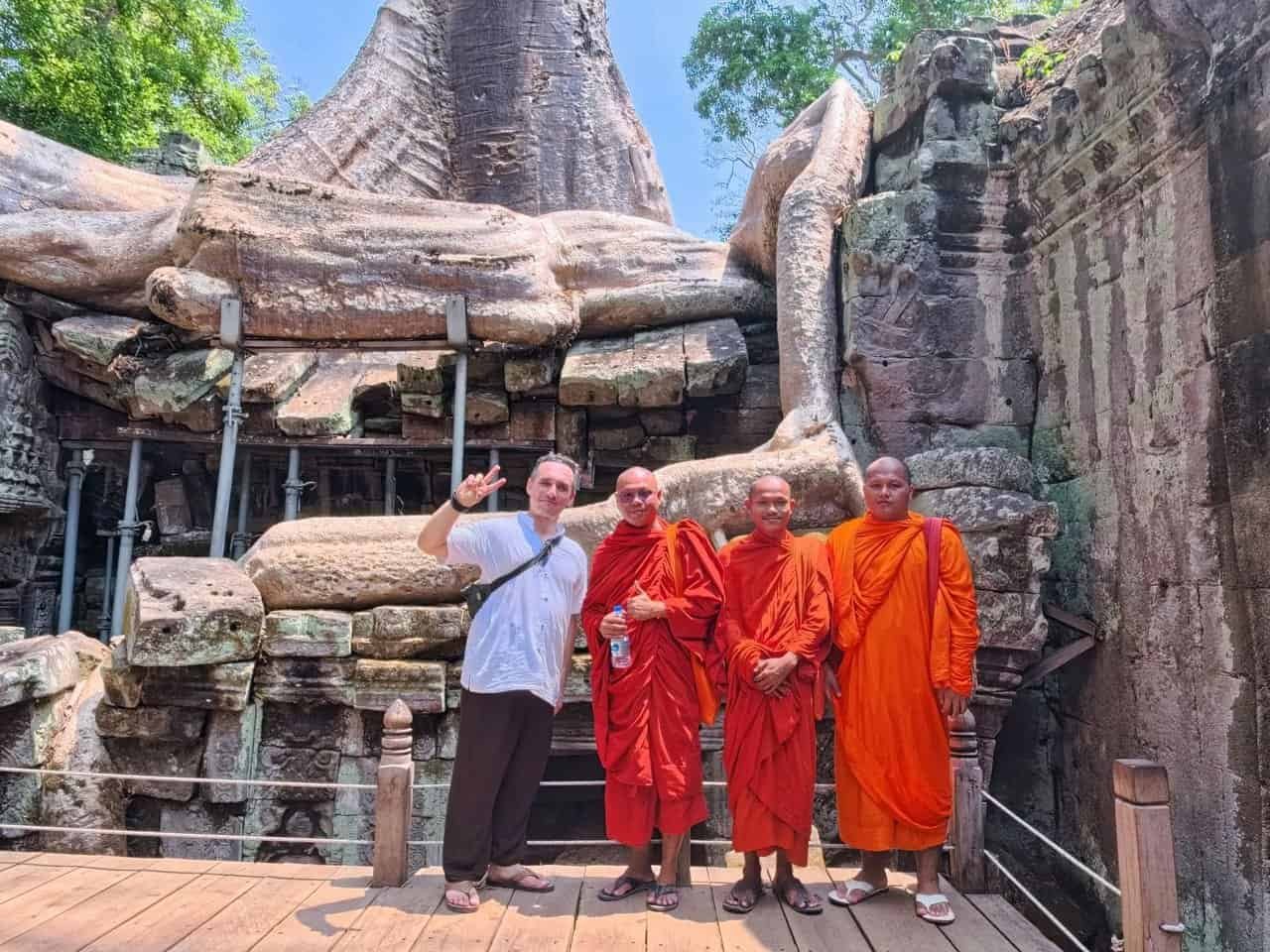
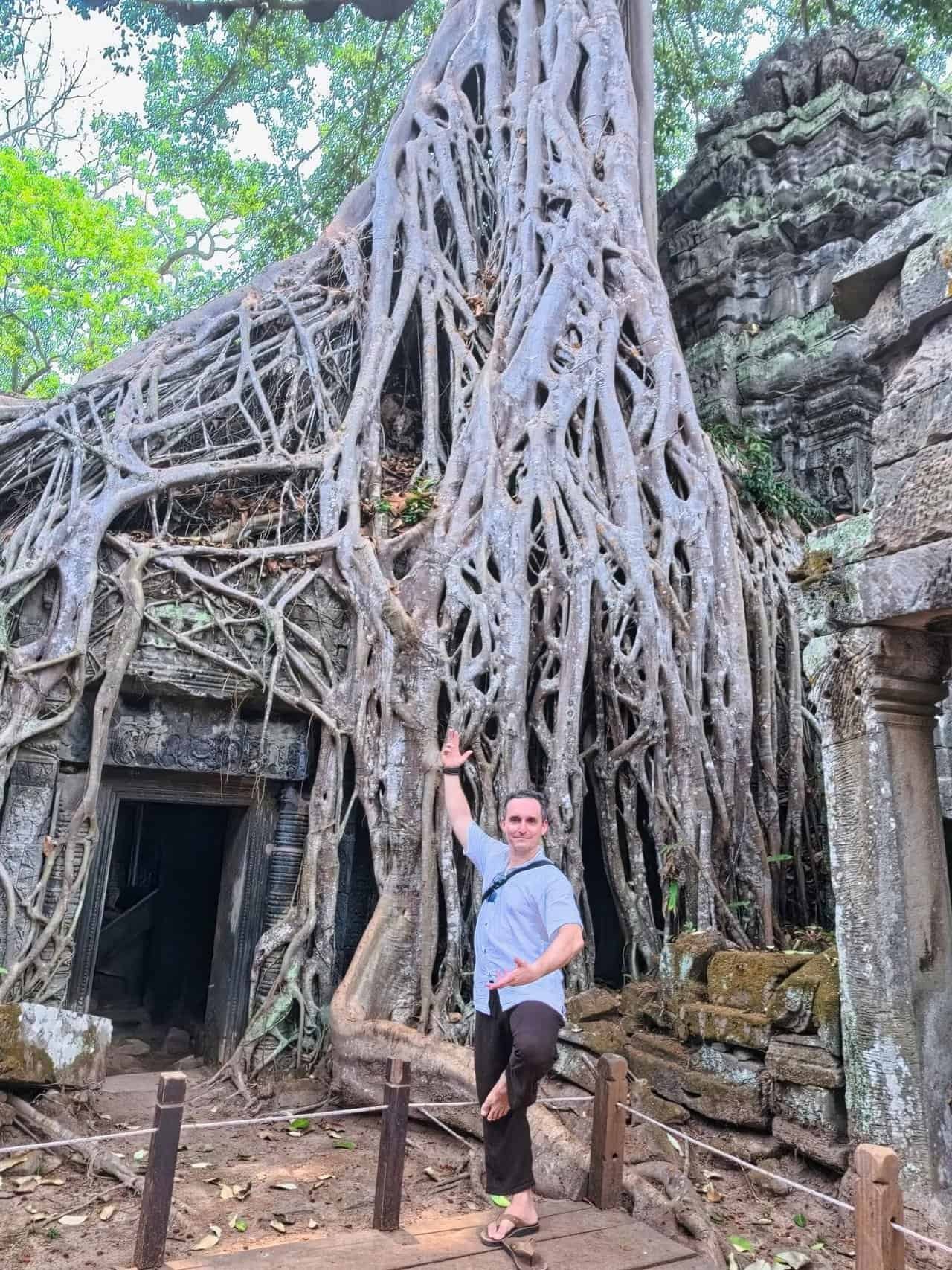
The temple itself is the wildest of the three. When restoration efforts began in the early 20th century, the École française d’Extrême-Orient deliberately chose to leave Ta Prohm largely as it was found. The result is what you see today: massive silk-cotton trees and strangler figs growing through, around, and over the sandstone, their roots simultaneously holding the structure together and tearing it apart. It’s the kind of place that looks staged but isn’t.
I made it to the famous Tomb Raider tree where Lara Croft picked the jasmine flower in the 2001 film. There was a queue. I got my photo, watched the next person step into position, and moved on. Less spiritual moment, more photo op — but standing in a place with that much accumulated history still hits, even with a line behind you.
The Long Hot Ride Back
By 1 p.m. we were cooked. We rode down past Srah Srang lake to a strip of food stalls and coffee shops, picked up some Khmer cakes, and ducked into a café for an hour of recovery. I took a half-nap on a couch. The temperature outside was climbing past 35°C and the body had checked out.

The ride back to Siem Reap was rough. Traffic on the main road had picked up significantly, and at one point everything came to a complete stop because a car had broken down — overheated — in the middle of the road. We crawled for 40 minutes. Once we cleared it, the road opened up and we cruised back through the late afternoon heat. I was in my apartment by 3 p.m., drinking water like a man who’d just walked across a desert, and I slept for two hours.
What Visiting Angkor Wat Actually Costs
Here’s the real number for a single day at the temples. The Angkor Wat ticket price is $37. Tuk-tuk in from Siem Reap was $2.80. Coffee, water, lunch, snacks ran me about $10. If you don’t have a friend with a motorbike, plan to add another $15-25 for tuk-tuk hire for the day or $8-12 for a motorbike rental. So a realistic budget is $55 to $75 for one solo day visiting Angkor Wat, Bayon, and Ta Prohm — what’s known as the Small Circuit.
That’s not cheap by Cambodia standards. A nice meal in Siem Reap runs $4-6. The $37 entrance fee alone is more than three days of food. I get why it’s priced this way — the money funds preservation across over 90 temples — but it makes a return visit hard to justify.
Practical Tips for Your Own Visit
If you’re planning your own day at the temples, a few things I wish I’d known going in. First, dress for the temples, not the heat. Knees and shoulders covered is required for entering the upper levels of Angkor Wat. Light cotton, long pants or a long skirt, sleeves. You’ll see a lot of people turned away at the climb to the top tower because they showed up in shorts. If you didn’t pack for it, Siem Reap has plenty of local shops where you can grab linen pants and a cotton shirt for under $15.
Second, get out before noon. The Cambodian sun at midday is brutal, and the crowds peak between 10 a.m. and 1 p.m. Angkor Wat sunrise visits are crowded, but the temple is still in shade and the temperature is bearable. By the time you’ve finished your sunrise visit and a coffee break, you can hit Bayon and Ta Prohm by 9 or 10 a.m.
Third, get a local guide if it’s your first time. My friend wasn’t a guide, but having someone who knew the framing spots, the history, and the timing made a huge difference. A licensed Angkor guide runs about $25-40 for a day and they bring stories that the stones don’t tell on their own.
Was Visiting Angkor Wat Worth It?
Yes — once. The temples themselves are extraordinary. Standing on top of Angkor Wat looking out over the causeway. Walking under the smiling faces of Bayon. Watching the trees of Ta Prohm crush and hold the stone at the same time. These are textbook bucket-list moments, and the textbook is right.
But I’m not rushing back. Between the $37 ticket, the constant approach from photographers and tour guides, and the ticket checks that consistently singled me out, the experience has friction baked into every step. A second day would mean another $37, more dodging, more checking. I’d rather take that money to Battambang or Kampot.
If you’re visiting Angkor Wat for the first time, do it. Go early, dress smart, bring patience for the hustle, and budget more than you think. You’ll come away tired, sweaty, sunburned, and changed. That’s a fair trade. Just don’t expect a peaceful spiritual experience — this is one of the most visited UNESCO sites on the planet, and it shows. The magic is real, but you have to earn it through the noise.
Have you visited Angkor Wat? Did you love it, hate it, or land somewhere in the middle like me? Drop a comment below and let me know what surprised you most.