It was too hot to do anything outdoors. My friend and I were finishing coffee and a bagel at New York Bagels in Siem Reap, trying to figure out how to spend the afternoon, when we both landed on the same gap in our list. I live in Siem Reap, and somehow neither of us had ever been inside the Angkor National Museum. I had read about it online and wanted to see if it held up in person. So we paid the bill, jumped on the motorbike, and rode over.
Here is the rundown on the Angkor National Museum: what it costs, what is inside, how long it takes, and where it falls short. Short version: it is worth a stop, especially on a scorching or rainy day, but the price runs high and the collection leans hard on stone.
Getting to the Angkor National Museum
The museum sits in town on the road out toward the temples, a short ride from Pub Street and most of the hotels in central Siem Reap. You can find it on Google Maps here. If you have not sorted out a base yet, our guide to where to stay in Siem Reap breaks down the neighborhoods.
Parking is easy. A parking attendant hands you a ticket for your motorbike, and whether you ride in yourself or get dropped by a tuk tuk, you end up right at the front door. The entrance is a good first impression: a wide approach with water and lily pads out front and the building rising behind it.

Bag Check and Tickets
Once inside, the bag check is on the left-hand side. Use it. Anything you do not check, you carry for the next two hours, and you will not want a backpack once you are leaning in close to the carvings. From there, head to the ticket window.
Angkor National Museum Ticket Price
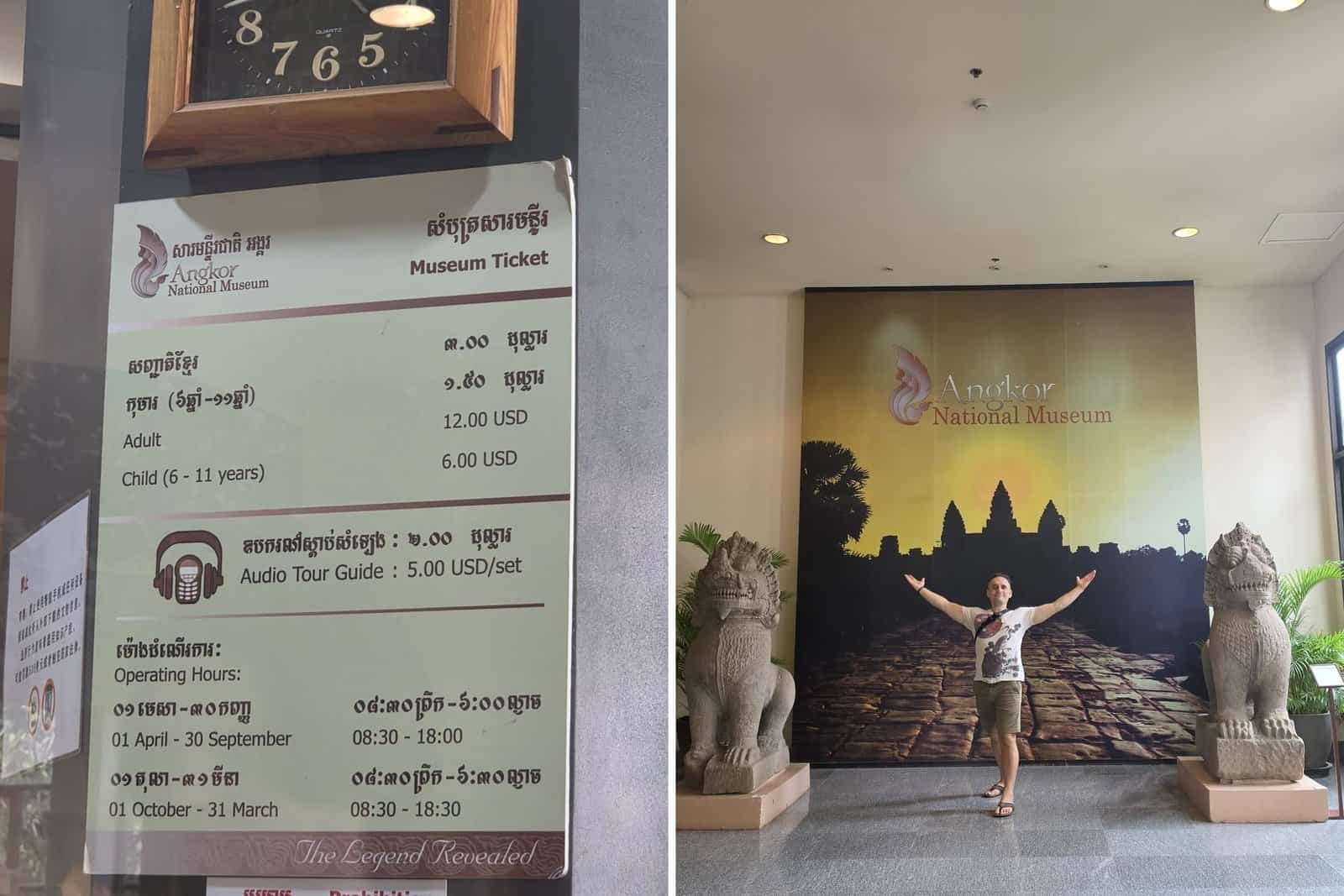
Here is what the board at the counter showed on our visit:
- Adult foreigner: $12
- Child (6 to 11): $6
- Cambodian nationals: $3 adults, $1.50 kids
- Audio tour guide: $5 extra per set
I paid the $12 and skipped the audio guide. Five dollars on top of a twelve dollar ticket did not feel like good value to me. My honest opinion is that the audio tour should be included with admission, or the museum should offer a free app you can run on your own phone with earbuds. That is my personal complaint, and the written displays carry most of the story anyway.
Hours run on two schedules. From April 1 to September 30 the museum is open 8:30 a.m. to 6:00 p.m. From October 1 to March 31 it stays open until 6:30 p.m. Get there by mid-afternoon at the latest so you have the full two hours. Some older websites list different hours and a cheaper audio guide, so trust the board over what you read online.
Inside the Angkor National Museum
The building feels modern from the moment you walk in. The museum opened in 2007 and is laid out as eight themed galleries, plus an orientation hall at the start. You do not wander at random here. The route takes you through in order, and it tells a story as you go.
The Welcome Video
You start by walking up a round rotunda to the top level, where you are brought into a screening room. A short film welcomes you, introduces the Khmer Empire, and lays out what you are about to see. Sit through it. It gives the rest of the museum context, especially if you have not visited the temples yet.
Gallery of 1,000 Buddha Images
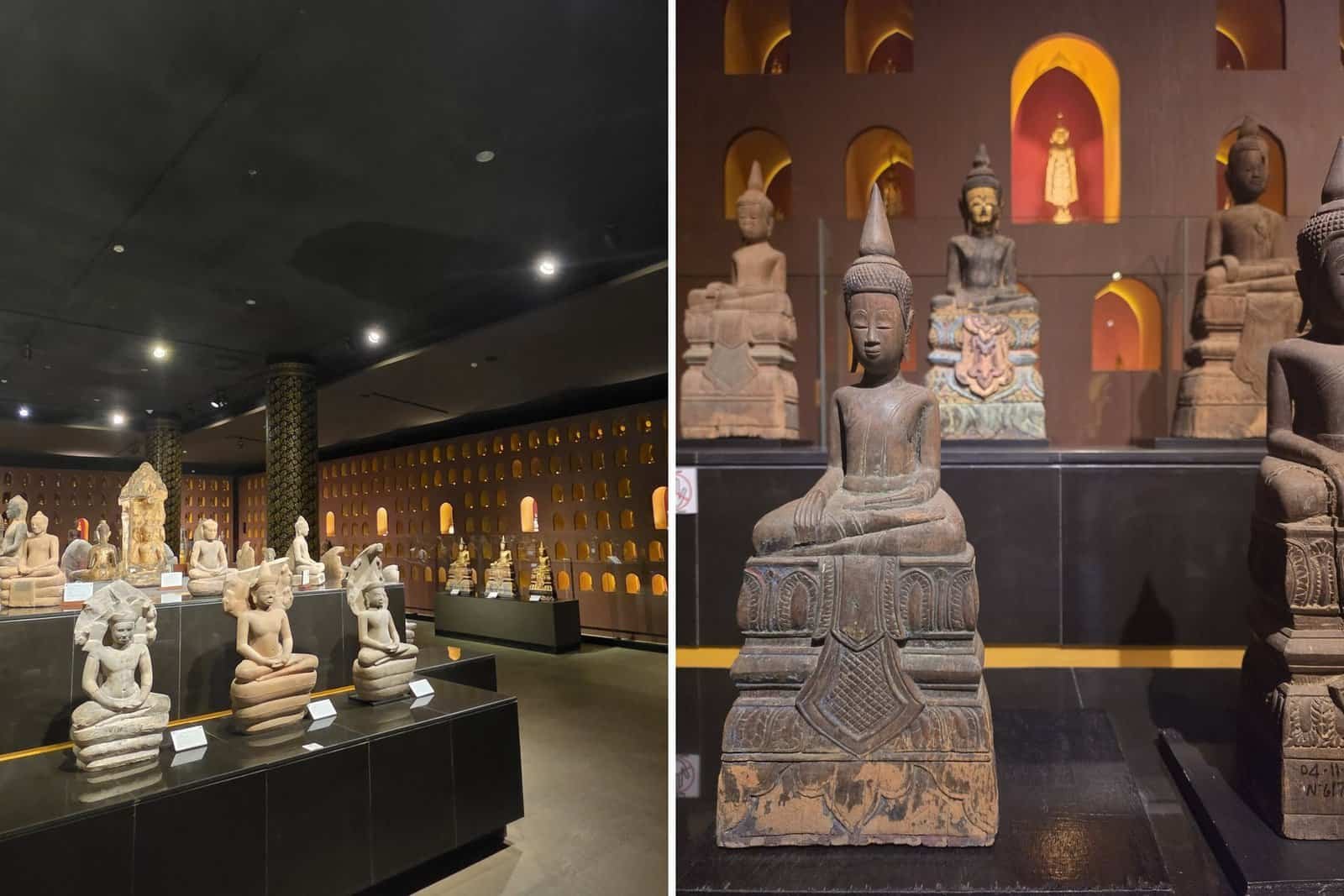
Our first stop was the Gallery of 1,000 Buddhas, and it is the room that stuck with me most. Small Buddha figures sit in lit niches that run along the walls, each one a slightly different carving and interpretation. Some are stone, some are wood, some are gilded. Walking the length of the room and comparing the faces is the best part. You start to notice how much the style shifts from one period to the next.
Khmer Kings and Cambodian History
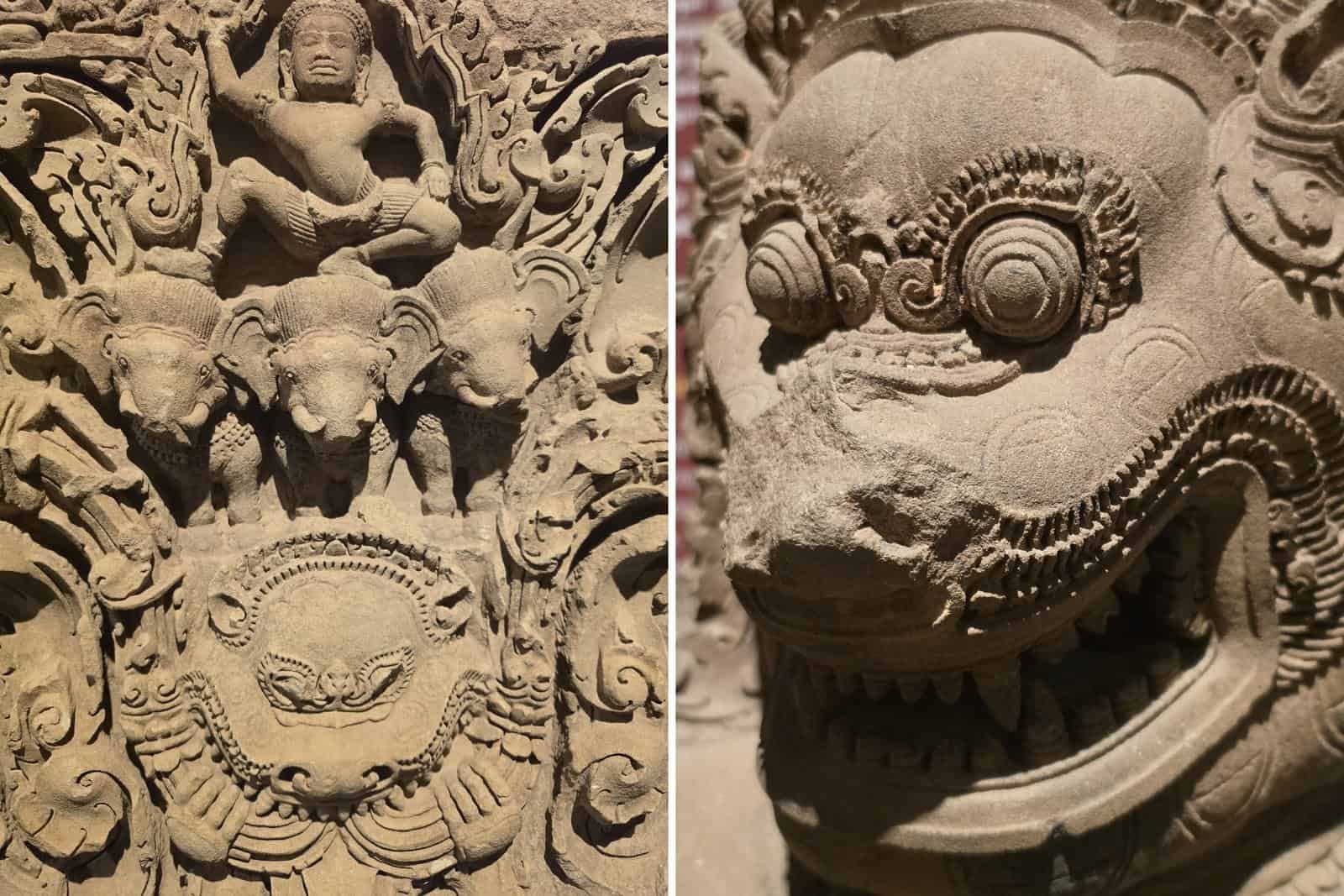
The next section covers the history of Cambodia through its kings, moving through different rulers, eras, and regions. This is where the sandstone sculpture really piles up. Statues, heads, and carved fragments trace who ruled, what they believed, and how the art changed under each reign.
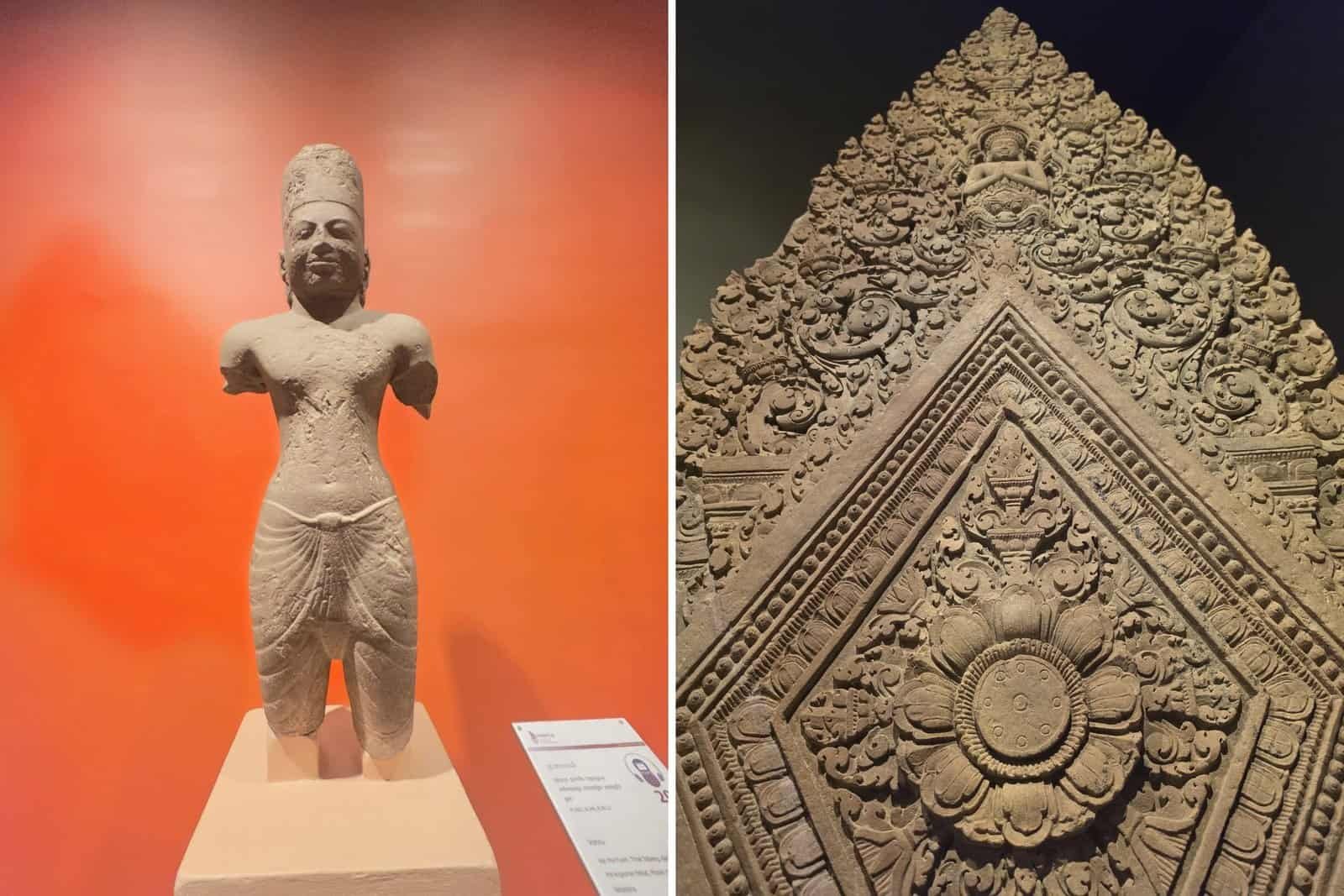
A lot of these sandstone pieces have incredible detail, and the museum lets you get close enough to see it. Lintels packed with tiny figures, temple pediments carved edge to edge, guardian lions, and a Buddha seated on a coiled naga. At the temples, a lot of this carving is high up, weathered, or roped off. Here it sits at eye level under good light, and that alone makes the visit worth something.
The Angkor Wat Gallery
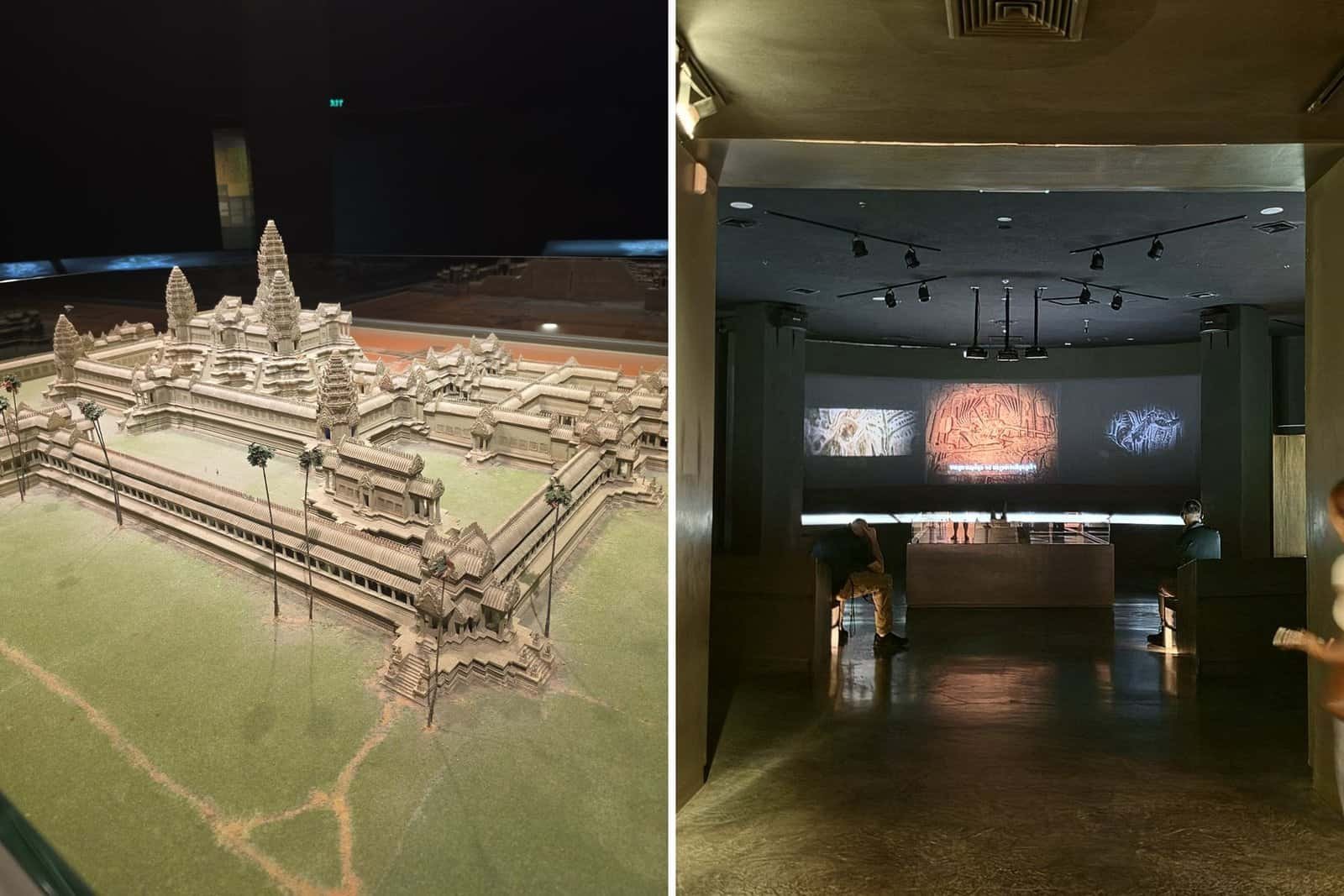
From there you head downstairs into the gallery dedicated to Angkor Wat. A big video plays on the screen, and there is a large scale model that shows the full layout of the temple complex from above: the moat, the causeway, the galleries, and the five towers. Even if you have already walked the real thing, the model is worth a long look. It is the only way to see the whole complex at once without a drone.
If you are planning to visit the temples after the museum, read up on the Angkor Wat dress code before you go, because the rules are enforced at the gate.
More Sculpture, More Buddhas, and Ancient Fashion
The galleries that follow continue the story with more history and sculpture, more Buddhas carved in different styles, and a section on Angkor Thom. There is also a wall-sized mural of the Churning of the Ocean of Milk, the Hindu creation story with gods and demons pulling on a giant serpent. It is the same story carved along the east gallery at Angkor Wat, and seeing it painted in bright color is a nice change from all the grey stone.
The section I found most fascinating covered the clothing people wore across the ages in Cambodia. It looks at dress, jewelry, and hairstyles as they appear on the carvings, and it changes how you look at every statue afterward. Once you know what you are looking at, the folds of a sampot or the shape of a crown start to tell you roughly when a piece was made.
The Coffee Shop, the Pool, and the Rain
Between galleries, the transition points open up onto a long reflecting pool that is worth stopping for. It breaks up the dark exhibit rooms and gives your eyes a rest.
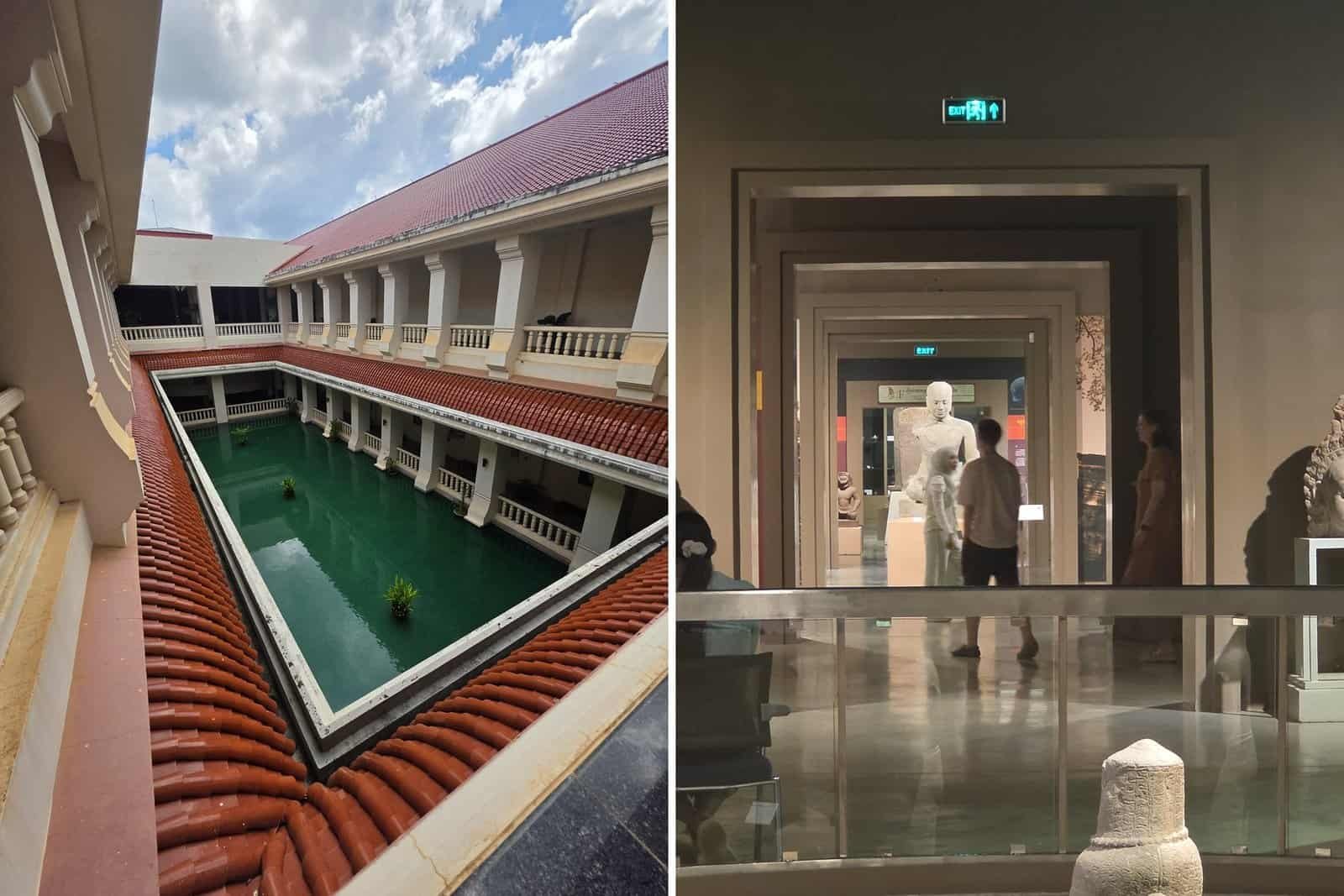
Near the end there is a small coffee shop with a garden outside and a fish pond to walk around. We sat there for a while before heading back. It started to rain, so we stayed put and watched it fall over the fish pond. That was one of the best moments of the afternoon, and it cost nothing extra.
Watch the Video
I shot a quick walkthrough of the visit. Here it is:
How Long to Spend at the Angkor National Museum
Plan on about two hours. That is how long we took at an easy pace, wandering through with a friend, stopping to watch the videos, and reading a good share of the displays. You could rush it in an hour, but you would skip most of the context, and the context is the point.
Every gallery is air conditioned, which matters more than it sounds. On a day when the heat makes the temples miserable, the museum is one of the best ways to stay out of the sun and still learn something. It works just as well on a wet afternoon in the rainy season.
And yes, you exit through the gift shop after the last gallery. The shop is pretty extensive. Browse it if you want, or walk on through.
What I Would Change
The Angkor National Museum is modern, well laid out, and full of impressive pieces. My main criticism is variety. Almost everything on display is sculpture. Stone Buddhas, stone kings, stone gods, stone lintels. It is beautiful work, but after two hours the rooms start to blur together.
I would have liked to see more types of exhibits: paintings, textiles, manuscripts, or other crafts that show Khmer life in a different way. Maybe sculpture is simply what the museum focuses on, and the stone carvings are what survived the centuries. Still, it left me wanting a little more than rocks.
My other complaint is the audio guide. Charging $5 on top of a $12 ticket feels steep, especially when the fix is cheap. A downloadable app with audio you can play on your own earbuds would make the whole experience better and cost the museum almost nothing.
Is the Angkor National Museum Worth It?
Yes. If you are visiting Siem Reap, the Angkor National Museum is well worth a stop. It is on the pricier side for what you get, and the collection could use more range, but the sculpture is exceptional, the story is told clearly, and the building is a comfortable place to spend a hot or rainy afternoon.
Here is who should go:
- First-time visitors to Angkor: go before the temples. The model, the videos, and the history give you a framework that makes the ruins easier to understand.
- Repeat visitors and residents: go for the close-up carving detail you never get at the temples.
- Anyone stuck in the heat or rain: two air conditioned hours that beat sitting in your hotel room.
Pro tip: skip the audio guide unless you know you want deep detail, check your bag on the way in, and give yourself the full two hours. For more ideas around town, see our list of things to do in Siem Reap and our take on Cambodia cultural attractions.
Bottom line: walk around for a couple of hours, get out of the heat, and then go have yourself a drink somewhere. If you want a calm spot afterward, here are a few quiet bars in Siem Reap away from the Pub Street noise.
Have you been to the Angkor National Museum? Did you pay for the audio guide, and was it worth it? Send me a message and let me know.