Part of my Thailand travel guide. See also the full Songkran in Bangkok story.
This is one piece of my full Siem Reap Travel Guide — a local’s take on the town I call home.
Songkran Bangkok vs Siem Reap: My Brutal 3-Day Verdict
I had a full week blocked out for Songkran in Bangkok. Seven days, April 9th through the 16th, 2026, ready to get drenched and take in the biggest water festival in Southeast Asia. I made it to day four before I changed my flight and bailed back to Cambodia. And when it comes to Songkran Bangkok vs Siem Reap, pulling the plug early turned out to be one of the smartest travel calls I made all year.
This isn’t a hit piece on Bangkok. The city delivered plenty. But what the Thai capital does during Songkran and what Siem Reap does during the same festival — called Choul Chnam Thmey on the Cambodian side — are two completely different animals. One is a massive, money-driven party built for a global tourism market. The other is a genuine community celebration where the spiritual bones of the festival are still visible underneath the water fights.
I’ve been kicking around Southeast Asia long enough to know how much marketing can oversell a festival. The Songkran Bangkok vs Siem Reap question is one a lot of travelers will face in the next few years, especially as word spreads about Cambodia as a cheaper, calmer alternative. Here’s what actually happened when I did both back-to-back in 2026.

Getting Around Bangkok During Songkran (Bring Cash and Walking Shoes)
Bangkok is a big city. I knew that going in. What I underestimated was how much that size would shape my daily experience during the festival.
The public transit looks good on paper but breaks down when you’re trying to crisscross the city. You can grab a Rabbit card for the BTS Skytrain, but that only works on one system. The MRT subway runs separately. Buses operate on their own thing entirely. Unless you’re going somewhere directly on the BTS Silom or Sukhumvit line, you’re paying out of pocket.
A Grab motorbike will run you around 45 baht for a short hop. A standard taxi across a chunk of the city is 200 to 300 baht. Multiply that by several trips a day during a week-long festival, and the costs add up fast.
My advice: pick a hotel within walking distance of whatever festival zone you’re targeting. If you want Silom Road, stay in Silom or Sathorn. If you want Khao San Road, stay in the old city. Don’t trust “centrally located” in a city this spread out — it almost never means what you think.
Why Bangkok Midtown Hotel Was the Wrong Songkran Base
My travel partner and I booked Bangkok Midtown Hotel for seven nights. Total came to $390 split between two people, which works out to about $28 a night each. Not bad on the wallet.
The problem was location. It looked “central” on a map but required either a 30-minute walk or a Grab ride to reach the main Songkran action on Silom. That got old by day three. The water gun gets heavy, your shoes are soaked, and you’re not in the mood to negotiate with a motorbike driver who’s just watched a waterlogged farang walk out of the hotel lobby.
Bangkok Midtown works fine for general sightseeing. For Songkran specifically, I’d trade the low rate for something walking distance to Silom or Sala Daeng BTS. You’ll save more in transport than you’ll spend on the room upgrade. Lesson learned.

SkyFlyers at Asiatique Before the Songkran Water Fights Began
Day one, before the water fights kicked off, we hit SkyFlyers at Asiatique The Riverfront. This thing opened in late November 2025 and is now the tallest giant swing ride in the Asia-Pacific region at 135 meters — the height of a 36-story building. It sits right next to Jurassic World: The Experience Bangkok, which is the themed tie-in.

Worth it. The swing spins you and 23 other riders in a wide arc while climbing to the top, where you get 360 degrees of the Chao Phraya River and the Bangkok skyline. I haven’t felt that particular mix of stomach drop and wide-eyed terror in a long time.
Tickets run around 320 baht. If you’re already in Bangkok and you’ve got a few hours before a flight or an evening event, Asiatique is worth the trip just for this ride. The Jurassic World part is a separate ticket and more geared toward families. SkyFlyers alone is the ticket to buy if you want the adrenaline hit.
Hitting Silom Road for the Songkran Opening Day
Friday was day one of Silom Songkran officially. My friend had plans with people he was catching up with, and I wanted to keep my budget intact, so I went solo.
Pre-game shopping took ten minutes. A colorful shirt from a street vendor, 159 baht. A water gun the guy wanted 200 baht for — I talked him down to 150. Done. Ready to fight.

Silom Road shuts down to traffic from Sala Daeng Intersection to Nararom Intersection for three days, from 1 PM to 9 PM. That’s the zone. Walk in through one of the BTS checkpoints, pass through screening, and you’re in.
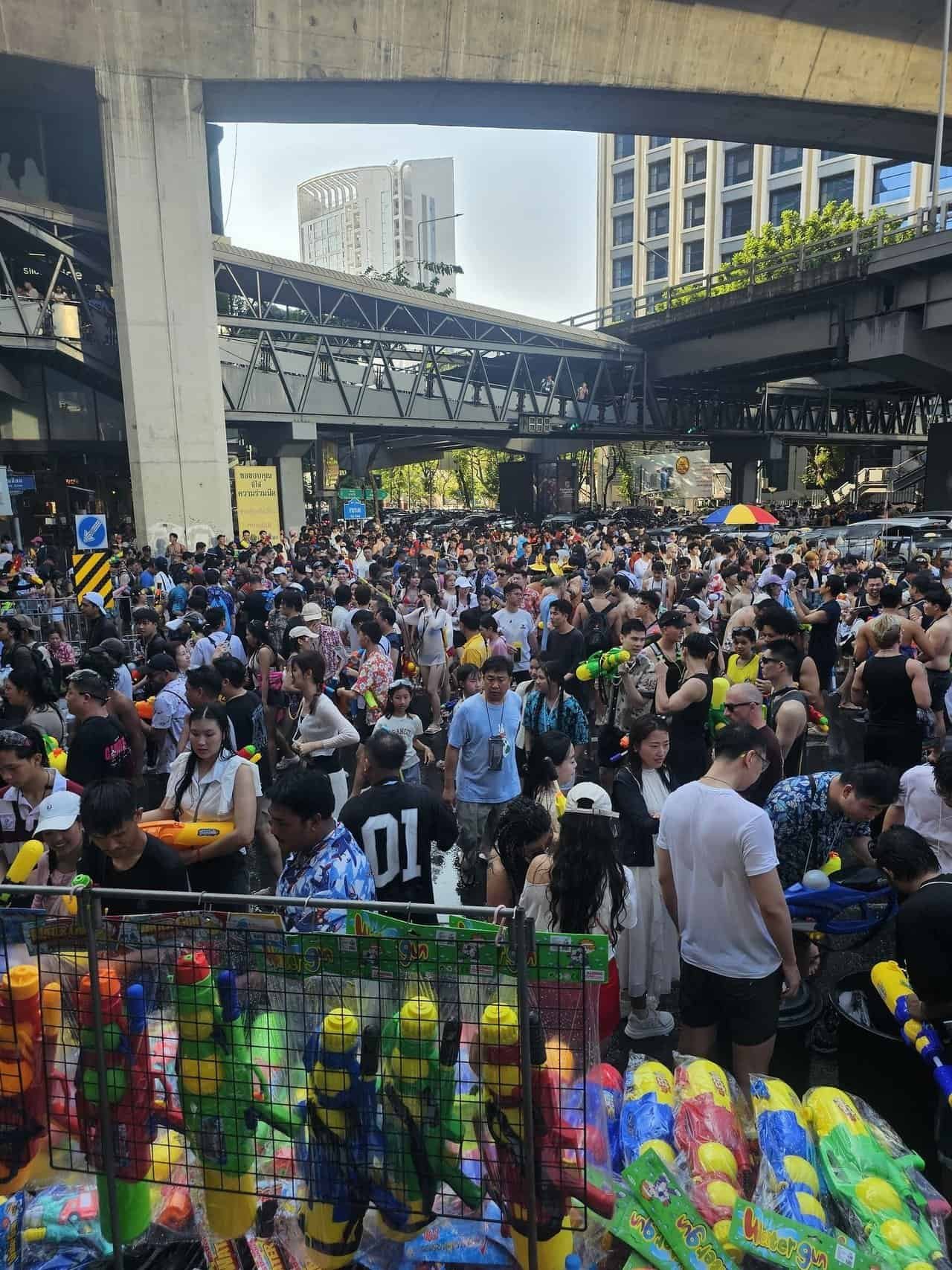
The afternoon stretch was genuinely great. Not too crowded yet. Music pumping from speakers along the road. Vendors selling water refills and beer. People spraying each other with good-natured grins. I was getting hit in the face constantly and trying not to think about where that water was coming from. More on that later.
When Silom Became a Sardine Can
By late afternoon, the mood shifted hard.
What had been a walkable, lively street turned into a crush. Shoulder-to-shoulder. You couldn’t pick your direction anymore — the crowd moved you. Getting bumped and pushed down the road stopped being fun and started feeling unsafe. I’d been in packed concerts before, but this was the first time in a while I started scanning for exit routes.

Turns out my read wasn’t me being soft. Silom Road drew about 140,000 people on opening day, according to Nation Thailand, and that number kept climbing. Thairath later reported the three-day total topped 650,000 revellers — nearly double the 2025 crowds. On April 14th, authorities officially closed the Silom festivities at 8 PM and funneled everyone out through a single controlled exit to prevent a stampede.
I bailed around dusk on my day there. Tried to head to a second event that evening but the line stretched forever and I called it. That was the night that tipped me toward leaving Bangkok entirely.
Songkran Bangkok vs Siem Reap: Why I Cut Bangkok Short
The next day my travel partner and his group wanted to spend the day drinking. I wasn’t in the mood, and I was already running the math on the rest of the trip.
Here’s how it broke down. My original round-trip Siem Reap to Bangkok DMK ticket was $203.97. Changing the return leg to fly out early cost me about $60 in change fees. Buying a new one-way ticket back would have run around $115. Staying three more days in Bangkok would have easily burned another $100 in food, transport, and beer — minimum.
Changing the existing ticket was the cheapest option by a wide margin. And the forecast for Silom was only going to get uglier — more crowds, more heat, more chaos. So I changed the ticket, grabbed a transfer, and flew back to Cambodia. Writing this on the 19th, I’d make the same call again without hesitation.

Bangkok wasn’t a bust. I just hit my ceiling earlier than expected. When you’re comparing Songkran in Bangkok and Siem Reap back-to-back the way I ended up doing, knowing when to fold is half the trip. If you’ve done the Pub Street scene in Siem Reap before, you already know what the slower pace feels like. That’s what pulled me home.
Songkran Bangkok vs Siem Reap: The Pub Street Difference
Siem Reap runs the same festival on the same dates, but it plays out completely differently.
I landed in time for the 14th, 15th, and 16th — the official Khmer New Year (Choul Chnam Thmey) dates. I spent those days walking Pub Street and the riverside, where most of the public celebration happens.

First observation: the crowds were real, but they were walkable. I never felt trapped. People were spraying water, dancing, getting drenched, and laughing. Kids ran around with water guns. Elderly folks watched from restaurant patios. The whole city was participating rather than one neighborhood being overtaken by tourists.
Second observation: 2026 was actually the first year Cambodia’s government formally banned water splashing in Phnom Penh, Siem Reap, and five other provinces, part of a deliberate push to steer Choul Chnam Thmey back toward its traditional roots. In practice, the ban on Pub Street was mostly ignored. But the energy was still noticeably calmer than what I’d just left on Silom. Informal splashing, yes. Stampede-level chaos, no.
Third observation: the water fight in Siem Reap is more of a side activity. The main events are the ceremonies, the Apsara dances, the traditional Khmer games, and the temple visits. The water is part of it, not the whole point. If you want a deeper read on how the city rolls out community-scale events like this, my piece on the Giant Puppet Parade in Siem Reap covers the same kind of energy in a different season.
The Spiritual Side Most Songkran Party Crowds Miss
This is where the Songkran Bangkok vs Siem Reap comparison gets interesting for me.
The festival — whether you call it Songkran, Choul Chnam Thmey, or Sankranta — is originally a Theravada Buddhist new year. The water represents cleansing: washing away the old year, washing the Buddha statues, pouring water respectfully over elders’ hands for blessings. That’s the core of it.
In Bangkok, I saw exactly one ritualized moment that tied back to that core: a procession down Silom with traditional dancers and a Buddha statue getting water poured over it. Even that felt staged — more photo op for tourists than religious moment for the community. I’m not saying no spiritual events happened in Bangkok during Songkran 2026. I’m sure there were plenty at temples and in local neighborhoods. But on Silom Road, where most tourists end up, the spiritual element was tertiary at best. The primary product on sale was party.
In Siem Reap, I watched monks pouring water on people’s heads on the last day of the festival. Public events were advertised with explicit religious framing. Families carried flowers and food to temples during the day before the water fights kicked off. The spiritual layer wasn’t hidden — it was front and center, with the party wrapped around it instead of replacing it.
Maybe I caught Bangkok at a bad moment. Maybe there’s a quieter Songkran experience in the Thai capital I missed because I was on the main drag. But the one I experienced on Silom felt more like Coachella with water guns than a religious new year. That’s a choice the city has made, and it works for millions of people. It didn’t work for me.

Health Warning: Protect Your Eyes and Expect to Get Sick
Let’s talk about water quality, because this part doesn’t get mentioned enough in festival coverage.
You’re getting sprayed in the face for hours a day, with water that’s come from a hose, a bucket, or a storefront’s questionable source. Some of it’s clean. A lot of it isn’t. Some of it has ice in it, which is refreshing until you realize where that ice came from.
Day one in Bangkok, I felt my right eye going hot and pink. Walked to a pharmacy, picked up antibiotic drops, used them morning and night for the rest of the trip. Probably kept a real pink eye episode from kicking in. In Thailand or Cambodia, any pharmacist can sort you out with this stuff in five minutes without a prescription. Do it at the first sign.
My other piece of gear: goggles. Get the cheap swim goggle kind. Some people at these festivals will straight-up aim for your eyes, whether accidentally or not. Goggles keep you in the fight longer and drop your infection risk dramatically.
By the 17th and 18th, back in Siem Reap and out of the water, I was dealing with a sore throat and a cough. Day 19 and I’m mostly recovered. That’s a realistic outcome for anyone doing three or more full days of festival water fights — plan for a recovery day or two on the back end.

Songkran Bangkok vs Siem Reap: Which Should You Choose?
Bottom line for anyone planning the Songkran Bangkok vs Siem Reap decision for 2027 or beyond:
Go to Bangkok if you want maximum spectacle — the biggest crowds, international DJs, rooftop events, and the bragging rights that come with doing Silom at peak chaos. Show up early in the day. Get out before 5 PM if you don’t like being in a human pressure cooker. Stay within walking distance of your target festival zone. Budget more than you think. Everything spikes during the festival.
Go to Siem Reap if you want the festival closer to its original scale. The party is still there on Pub Street, but you can actually move. The religious and community elements are visible. Costs are dramatically lower — my entire week in Siem Reap will come in under what three more Bangkok days would have cost. Flights from Bangkok’s Don Mueang (DMK) to Siem Reap run around $100 one-way if you want to combine both cities in one trip.
If you’re really ambitious, do both on purpose. Two days in Bangkok for the spectacle, then fly to Siem Reap for the community-scale experience. That’s the trip I’d build next year, with every lesson from this one baked in.
Final Take on Songkran Bangkok vs Siem Reap
Bangkok and Siem Reap aren’t really competing for the same traveler during the water festival. They’re offering different products under the same name. The Songkran Bangkok vs Siem Reap question comes down to what kind of trip you actually want and how much chaos you’re willing to tolerate.
Bangkok scales up. Siem Reap scales down. Bangkok sells the spectacle; Siem Reap still practices the festival. Both are valid — neither is wrong. But after spending three days in each side-by-side, I know which one I’ll be making my home base for the next one.
There’s also an ongoing debate between Thai and Cambodian cultures about which country originated the water festival tradition. I’m not tossing my hat in that ring. Both have interesting claims, and I’d recommend any serious traveler experience both to see the full spectrum. At its heart, this is still supposed to be a religious festival about cleansing and new beginnings. Worth holding onto that when you’re getting blasted in the face by a stranger with a pressure gun.
Have you done Songkran in either city, or are you planning to in 2027? Drop a comment with your take — especially if you hit a different part of Bangkok and had a better experience on the spiritual side. I’d love to hear about the spots I missed.